Navy News
Direct from the front-line, the official newspaper of the Royal Navy, Navy News, brings you the latest news, features and award winning photos every month.
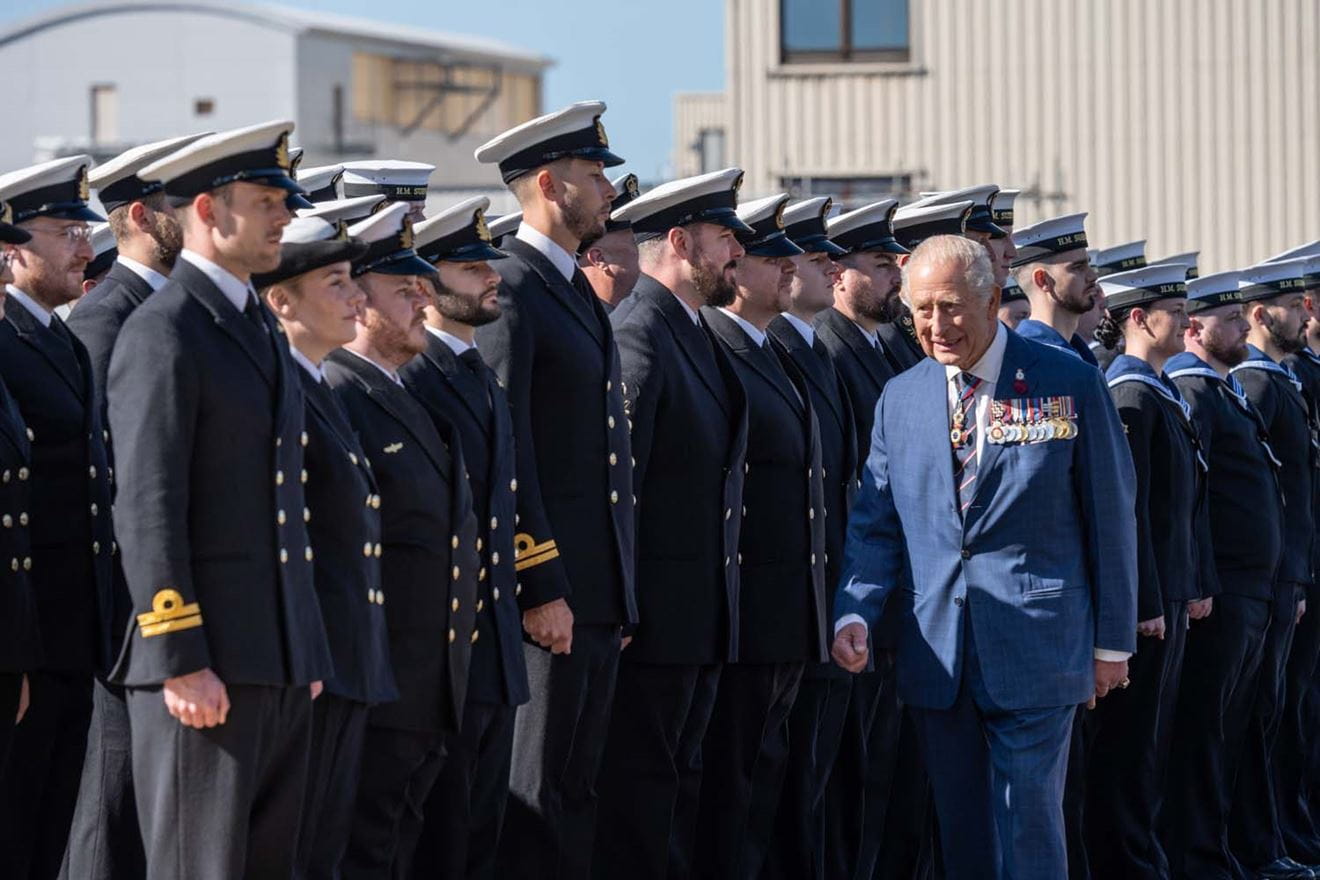
He joined around 500 guests – family members, VIPs, senior politicians and military leaders – as the hunter-killer submarine formally joined the naval family at BAE Systems’ yard in Barrow-in-Furness, where Agamemnon has taken shape over the past 12 years.
In a rare change to naval tradition, King Charles read the commissioning warrant – declaring Agamemnon ready to take her place alongside the rest of the Fleet.
That act – typically performed by the Fleet Commander – largely ended formal proceedings, after a service blessing the boat and her crew led by Chaplain of the Fleet Reverend Doctor Mark Davidson and Agamemnon’s skipper Commander David ‘Bing’ Crosby.
Secretary of State for Defence John Healey, First Sea Lord General Sir Gwyn Jenkins and Charles Woodburn, head of BAE, also addressed guests before His Majesty arrived, taking the Royal Salute from the submarine’s Guard, before meeting principal VIPs, including Guest of Honour Lady Sarah Jane Sedwill, who has followed the progress of the boat and her 100 men and women since being named HMS Agamemnon’s sponsor.
She praised all in ‘Team Aggie’ for the efforts to bring the cutting-edge submarine to the cusp of front-line operations providing “silent security to defend our nation, allies and interests for many decades to come”.
She continued: “Over the past two years I have watched HMS Agamemnon become the awesome vessel being commissioned today. Just as awesome is the commitment of her crew, and their families and friends who support them.”
Agamemnon is the fourth Astute-class submarine Commander Crosby has commanded.
He said the national endeavour – industry, sailors and submariners, contractors, civil servants, naval architects, engineers, technicians, computer and systems engineers – behind the boat had created a machine which “stands at the forefront of modern submarine warfare in the most unforgiving of all battlespaces”.
His boat will now continue preparations to leave the BAE yard and sail to her future home at HM Naval Base Clyde, where she will join her five sisters, already in service.
Once operational, Agamemnon’s mission will be both sword and shield of the Fleet, protecting the nuclear deterrent, carrier strike groups and critical underwater infrastructure, and striking foes where necessary with Spearfish torpedoes against hostile surface vessels and submarines, or Tomahawk cruise missiles to hit land targets up to 1,000 miles away.
First Sea Lord General Sir Gwyn Jenkins said like the rest of the Astute class, HMS Agamemnon would be “pivotal to our national security” taking her place in the line of battle in a Royal Navy “that is ready to fight and able to win - respected by allies, feared by enemies and the pride of our island nation”.
He continued: "The commissioning of the sixth Astute class submarine, HMS Agamemnon and the steel cut for the fourth Dreadnought-class submarine, HMS King George VI, mark significant milestones in the Royal Navy's enduring commitment to safeguarding our nation.
“These achievements underscore the critical role of the Continuous at Sea Deterrent in ensuring our security and the importance of cutting-edge warfighting capabilities in an ever-evolving threat landscape. I would like to extend my deepest gratitude to the exceptional workforce at Barrow, whose dedication, skill, and innovation continue to drive forward these vital programmes, ensuring the Royal Navy remains at the forefront of global maritime defence."
She is a product of stealth, equipped with world-leading sensors and is crewed by a highly-trained and dedicated crew. Together, they form a formidable capability, vital to protecting the United Kingdom’s security interests and supporting our global responsibilities
The submarine is the sixth Royal Navy vessel to carry the name (taken from the Greek king from the Trojan Wars), going back to the late 18th Century and a 64-gun third-rate man o’war which was captained by the future Admiral Lord Nelson in the mid-1790s.
He regarded Agamemnon as his favourite ship – and it is fitting that oak from the New Forest which was used to build her has been donated by Buckler’s Hard Maritime Museum and used to create the submarine’s battle honours board.
In a red letter day for the Silent Service, shortly before the commissioning the first steel was cut to begin work on the final Dreadnought-class nuclear submarine.
HMS King George VI – named after King Charles’ grandfather – will be one of four submarines carrying out Operation Relentless, the longest-standing mission in the Royal Navy’s history, conducted unbroken since 1969.
All, like the Astutes, are being built in the cavernous Devonshire Dock Hall which dominates both the BAE works and the town of Barrow and cements its position as the home of submarine building in the UK.
To acknowledge the role the Cumbrian town has played in the nation’s defence, in particular building warships and submarines, for more than 150 years, His Majesty visited the town hall following the commissioning ceremony to formally bestow the title ‘Royal’ on the Port of Barrow.
It joins five other towns, such as Royal Wootton Bassett, already honoured with the regal prefix.Direct from the front-line, the official newspaper of the Royal Navy, Navy News, brings you the latest news, features and award winning photos every month.