Navy News
Direct from the front-line, the official newspaper of the Royal Navy, Navy News, brings you the latest news, features and award winning photos every month.
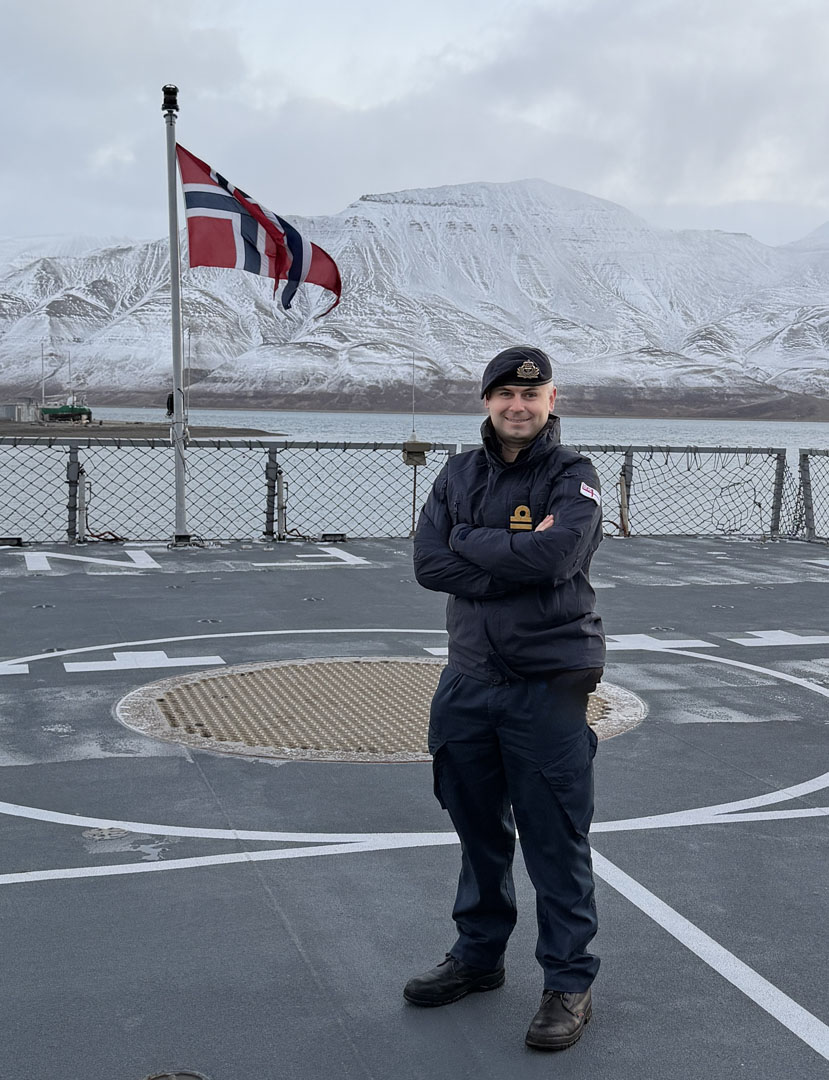
Svalbard, which lies 400 miles beyond the northernmost tip of mainland Europe, occupies a key strategic position, acting as one of the ‘posts’ on the Russian Northern Fleet’s gateway into the North Atlantic.
Under international treaty there is no permanent military presence in Svalbard, but the islands are patrolled by the Norwegian Navy, which dispatched the frigate HNoMS Fridtjof Nansen for the latest tour of duty.
Joining the ship for the patrol was Lieutenant Wright, the Royal Navy’s exchange officer with the Royal Norwegian Navy, allowing him to experience – and understand – how different fleets operate and the challenges they face.
Lt Wright is usually embedded with the Skjold-class Corvette Squadron – the small, fast, heavily-armed missile boats which prowl the fjords – but jumped at the opportunity to join his Norwegian comrades to head to the Very High North and one of the most remote archipelagos in the world.
“These islands at the end of the world are an important strategic asset for Norway,” he explained. “As UK and Norway industry and military cooperate more and more through entities such as the Joint Expeditionary Force (JEF), this archipelago will become increasingly strategically important for the UK, and thus for the Royal Navy.”
Given its latitude, Svalbard is a hostile environment in which to operate, enduring constant sub-zero temperatures since the beginning of October.
After the sun set on October 27, it won’t appear again until after Valentine’s Day. Sailors maintain lookout for low-lying icebergs (known as ‘growlers) which bob in the waters surrounding the islands. All but invisible to radar, during snowstorms they can be particularly difficult to spot.
Sustained operations at the same latitude as Svalbard – between 74 and 81 degrees North – pose numerous challenges, not least potential icing on deck which is prevalent for more than eight months of the year.
“There’s the obvious danger of slipping and falling overboard, particularly when the flight deck nets are lowered for helicopter operations.
“Cold water shock is one of the biggest contributors to drowning and has an effect when the sea temperature falls below 15°C. In high summer, the warmest the sea will be around Svalbard is around 7°C.”
The second, more subtle – and potentially – greater danger is the impact of ice on a ship’s stability.
“Water, and consequently ice, is heavy,” Lt Wright explains. “One litre weighs one kilogramme. As ice builds up on the upper decks, the effect is no different than adding a lot of weight high up, and risking making the ship top heavy.”
That means crew have to head out on deck in sub-zero temperatures to clear the ice – redolent of scenes from the Arctic convoys of World War 2 – and brings with it the risk of slipping overboard.
As for the islands themselves, there’s a stark beauty to them. More than 90 per cent of Svalbard is uninhabited, providing one of the most extreme examples of raw natural beauty in the tundra environment anywhere in the world.
It’s home to no more than 2,500 souls, almost all of them in the ‘capital’ Longyearbyen (pronounced long-year-BEE-en), which is the largest town this far north (800 miles inside the Arctic Circle) and where snowmobiles outnumber cars. Once a thriving mining colony, since the winding down and finally demise of the industry with the closure of the last mine earlier this year, the economy relies on tourism.
It’s become renowned for its polar bear populace (circa 300) which thrive thanks to Svalbard’s plant life. The bears roam freely around the islands and generally stay clear of built-up settlements, although owning a firearm is not only permitted but also encouraged just in case you’re endangered.As UK and Norway industry and military cooperate more and more through entities such as the Joint Expeditionary Force (JEF), this archipelago will become increasingly strategically important for the UK, and thus for the Royal Navy.
Direct from the front-line, the official newspaper of the Royal Navy, Navy News, brings you the latest news, features and award winning photos every month.