Navy News
Direct from the front-line, the official newspaper of the Royal Navy, Navy News, brings you the latest news, features and award winning photos every month.
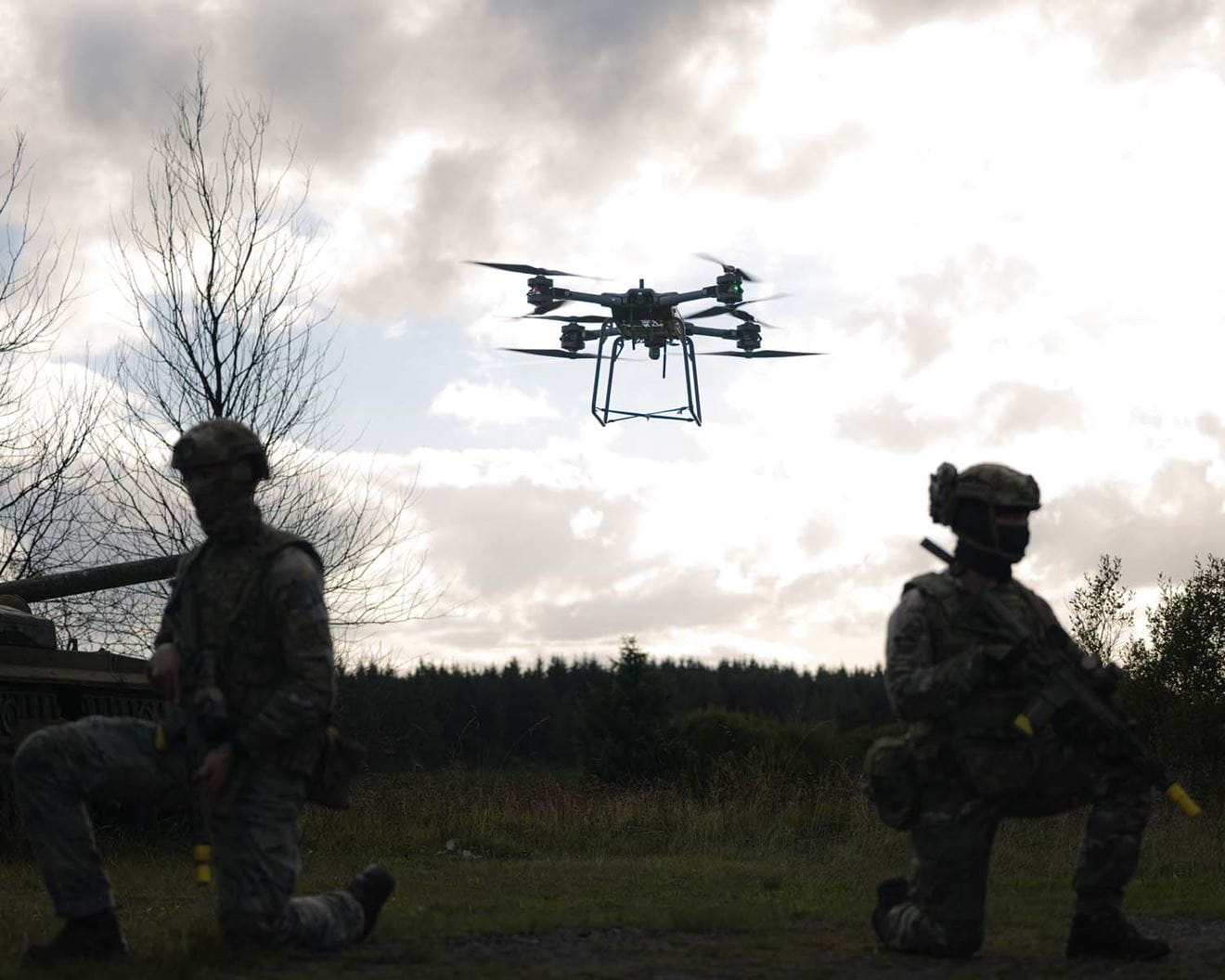
The evolving procedures Malloy Flight, Delta Squadron, of Devon-based 48 Commando (Support Group) Royal Marines are working on will mean a freshly-trained drone team can prepare and launch their drones within three minutes during the day and five minutes at night.
The squadron decamped to the Spadeadam Training Area in Cumbria for five days to work on tactics for launching their Malloy quadcopter – capable of carrying up to 63kg – while in combat, increasing drone teams’ survivability by reducing setup and preparation time before launch.
The ultimate aim was to keep pace with battlefield developments – those seen in Ukraine, for example, so that drone teams can launch their machines before the ‘enemy’ detects them electro-magnetically or otherwise and attempt to destroy them.
Major Rhys Adkins, Officer Commanding of Delta Squadron, said: “The rehearsals during Strike Warrior are a vital step forward as the UK Commando Force keeps pace with ever-changing and evolving drone battlefield tactics.
“In any modern operation, we must be ready to deploy drones rapidly at a moment’s notice. Continually scrutinising our tactics and procedures means that when called upon we will be a well-oiled machine ready to deliver on the front line.
“The activity at Spadeadam shows we can rapidly equip commandos with the skills necessary to deliver drone operations wherever they are required, but we must continue to analyse, test and evolve to ensure we do not fall behind.”
The drones were airborne day and night, flying beyond visual line of sight to deliver critical supplies to commandos on the front line.
They repeatedly rehearsed logistical supply drops in areas with heavy surveillance, proving that in under a day new drone teams can learn to safely setup, prepare a load and launch a sortie.
“Malloy matters to the commando on the ground because it means that they don’t have to carry as much equipment,” explained Major Adkins.
“They sometimes don’t even have to be there or they can have an effect 12 times their number with one uncrewed system.
“It means that we can do more with less and use our people in a better place or in an alternative area and keep them safer whilst being more lethal.
“This is directly in line with where the First Sea Lord wants us to go. It fits within the hybrid navy concept and going forward into the war fighting headmark for 2029, but arguably we’re proving that the capability works now. Ready to go where we need at a moment’s notice.”
The training in Cumbria was part of Exercise Strike Warrior 26, which saw more than 2,000 personnel from six nations (UK, Netherlands, Canada, Germany, Norway, USA) deployed across Scotland, including the Western Isles, North-West Approaches, Galloway, the Borders region and the North Sea.
The commando-led exercise designed to rehearse allied crisis-response operations in the High North and North Atlantic region and was the largest test of all the elements of the UK Commando Force in 15 years.
Direct from the front-line, the official newspaper of the Royal Navy, Navy News, brings you the latest news, features and award winning photos every month.