Navy News
Direct from the front-line, the official newspaper of the Royal Navy, Navy News, brings you the latest news, features and award winning photos every month.
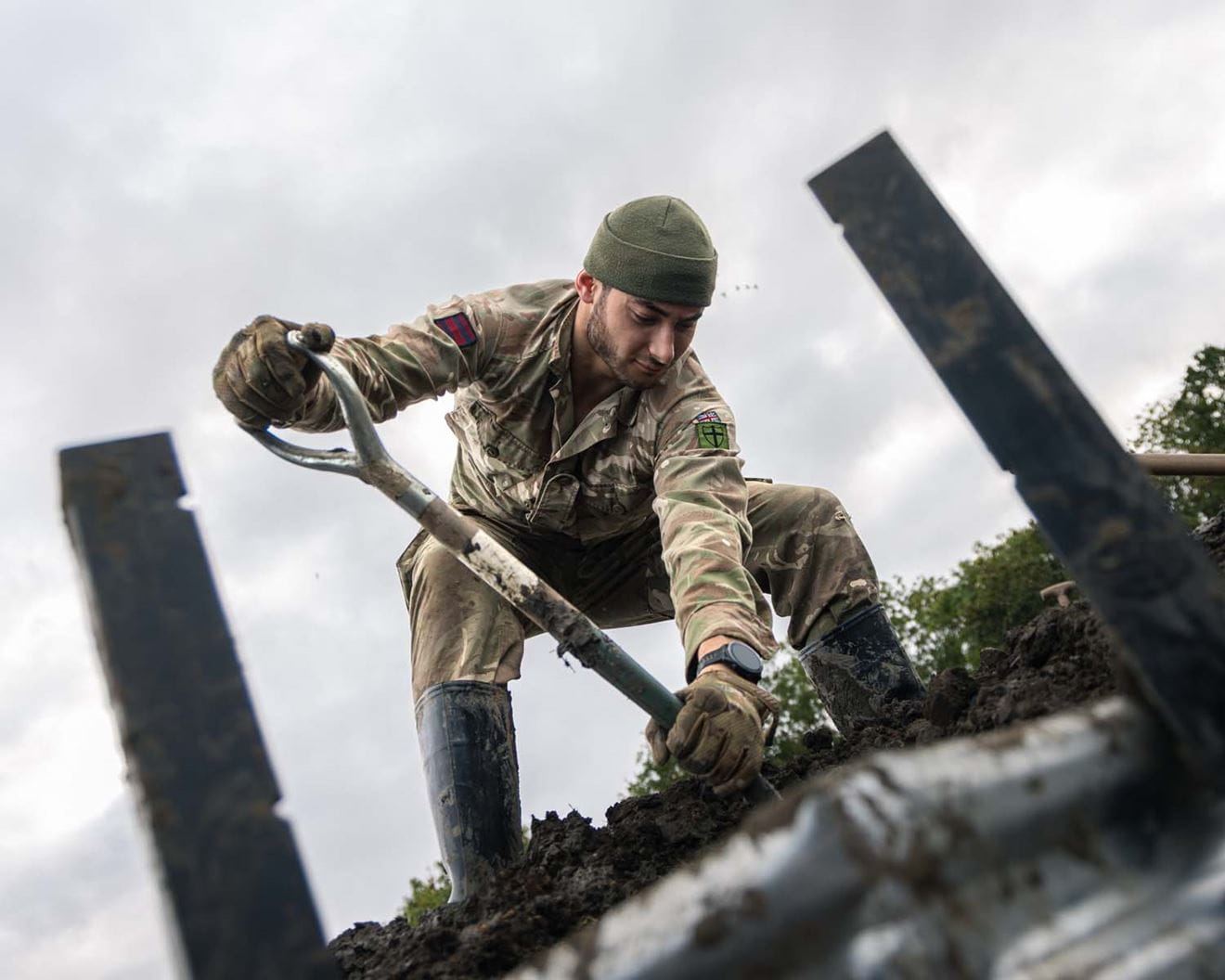
24 Commando Royal Engineers spent six days constructing a 20m x 20m facility – about the size of one-and-a-half tennis courts – excavating approximately 243 cubic metres of rock and soil to create the subterranean casualty complex at Barnsford Bridge near Glasgow.
Once completed, medical specialists from the Special Operations Surgical Team, and the Commando Forward Surgical Group from 48 Commando were able to resuscitate ‘casualties’ and perform ‘surgery’ on troops taking part in Exercise Strike Warrior in south west Scotland.
As technology and threats evolve in conflicts – from drones to missiles – so too have the developments of medical facilities to meet modern needs and using underground spaces, whether created from scratch or using pre-existing places like caves or tunnels, can prove hugely valuable for protection and concealment.
This has led to the medical personnel who deploy on UK Commando Force operations across the globe to look at the practicalities of working in subterranean spaces, taking inspiration from the work of Ukraine’s medics.
Ultimately the temporary facility at Barnsford Bridge is part ongoing efforts to develop, trial and standardise subterranean facilities for future use across the Commando Force and Corps of Royal Engineers, going from this prototype to full operational capability.
Lieutenant Michael Mathers, Access Troop Commander of 54 Commando Squadron, who were tasked with project, said: “By designing, constructing, and handing over this facility, our troops gained first-hand experience of the realities of modern peer-on-peer conflict, where survivability, protection, and concealment are critical to success.
“Beyond delivering a unique capability, the project provided invaluable engineering training across multiple trades, challenging our soldiers to develop new skills and adapt established techniques to a novel environment.
“Equally important, it highlighted where we must continue to innovate, ensuring lessons identified are refined, shared, and integrated in future designs and shared across UK Commando Force and the Corps of Royal Engineers.”
Medics and engineers worked together on the design, understanding the medical requirements for the facility and outlining the building limitations – such as the design of the trench system to offer maximum blast protection.
A clinical hospital environment placed in what is essentially a hole in the ground presented many challenges including soil contaminants, bacteria, pests and environmental aspects that can reduce clinicians’ performance and functionality as well as casualties’ survivability.
The engineers moved in with vehicles, plant, and engineering equipment to the construction site to carry out excavation, revetment, construction, and fortification over six days.
Once built, the medical teams could explore the compartments to look at the possibilities and limitations: how to allocate power, how to move casualties based on their needs and how to move around.
They went into detail in other aspects such as pest control and temperature monitoring, looking at environmental control to protect casualties from additional risks.
Chief Petty Officer Ellie Walls of Commando Forward Surgical Group, said: “We can look at the lessons learnt from Ukraine and other medical uses of the subterranean space but we have to start experiencing the issues for ourselves to really understand and work through the problem.
“When looking at using the subterranean space, we have to evaluate if the risks from being below ground outweigh the risks from being above ground.”
She added: “As an organisation we see the need to develop our ability to build, survive, work and live in these spaces as medics now are not always protected by the Red Cross and can be routinely targeted.
“However, our demands can be quite specific, we have to take into account the needs of the casualty and ensuring the environment does not negatively impact their outcome.”
The impact of working underground on clinicians’ wellbeing shouldn’t be underestimated – they are used to working in spaces which have space, light, air circulation, plumbing and electricity, with the freedom to move around and resupply.
The opportunity to work in a subterranean space during Exercise Strike Warrior has allowed medical teams to look at how they would occupy and set up and the issues we would encounter.
“Whilst it has given us some answers it has generated a lot of questions and thoughts,” added CPO Walls. “If we can prepare our equipment and people to work in such areas, we give our patients a better chance of survival.”
Direct from the front-line, the official newspaper of the Royal Navy, Navy News, brings you the latest news, features and award winning photos every month.