Navy News
Direct from the front-line, the official newspaper of the Royal Navy, Navy News, brings you the latest news, features and award winning photos every month.
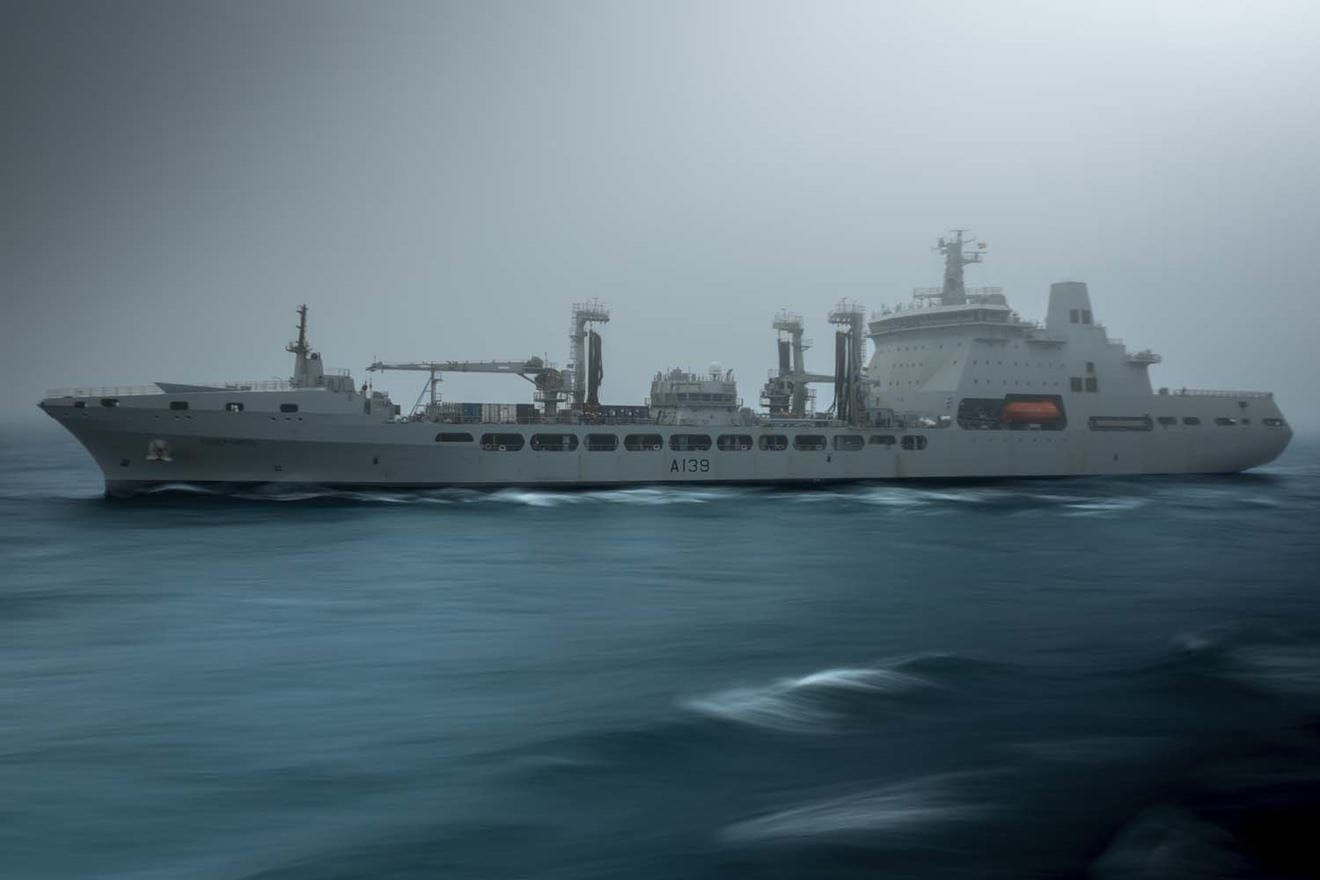
RFA Tideforce was at the heart of allied security operations across the North Atlantic and Arctic, delivering more than 2.9 million litres of fuel and becoming home to a submarine-hunting Merlin helicopter for intelligence sorties and missions reporting on Russian activity.
The tanker supplied French and Dutch warships in the High North and supported both HMS Queen Elizabeth and HMS Prince of Wales during carrier operations.
All of these missions were completed under Commander Task Force 320, which delivers maritime security operations, anti-submarine warfare and day-to-day oversight within UK waters.
Captain Chris Clarke, Commanding Officer of RFA Tideforce, said: “The unpredictability of 320 operations is still as rewarding as it ever was – whether that be in understanding the intelligence picture, delivering operational output, enjoying the variation in tasking, the violent weather challenges or conducting complex repairs at sea to keep the ship on task.
“It all plays out in the hands of the RFA seafarer – especially when the ‘Force’ is with you. It’s what we do; it’s what we’ve always done and it’s what we will do for many more years to come.”
Embarked throughout was a Merlin helicopter from 814 Naval Air Squadron based at Royal Naval Air Station Culdrose in Cornwall, which used Tideforce as a launchpad for intelligence-gathering activity, including operations involving Russian units in both the English Channel and North Atlantic.
Operating in the High North brought its own challenges, with demanding weather conditions at times forcing the ship to seek shelter off Iceland’s northern coast. The ship’s company later faced Storm Boelo, waiting out off the coast of Ireland.
Despite the weather, the deployment offered some extraordinary sights. During a midnight to 0400 watch, under a low, full moon, fortunate members of the watchkeeping team witnessed a rare natural phenomenon: a ‘moonbow’, or lunar rainbow, created when moonlight refracts through water droplets.
The Northern Lights were also a regular treat for the night watches.
As Tideforce crossed into the Arctic Circle, 35 members of the ship’s company were welcomed into the Realm of the Blue Nose. The traditional naval ceremony saw the fresh-faced sailors receive a suitably frosty reception from King Neptune before being rewarded with hot chocolate and cookies to help warm them up.
Cadet (X) Finley Groves said: “As a Cadet taking part in his second trip with the RFA, I can wholeheartedly say that I have picked the right career for me. Whilst I don’t think I have stopped moving for more than five minutes these last few weeks, I have felt privileged to have experienced new things almost every day this trip.”
APP(CIS) Rio Owen added: “As a communications apprentice who’s undergoing their first sea going appointment, following a brief stint alongside, the contrast is much greater than I expected.
“I’ve now had a real opportunity to immerse myself into the true nature of what the RFA is all about. From experiencing thrilling helicopter flights as well as being at the centre of the RFA’s most vital role in the UK’s strategic defence i.e., Replenishments at sea, specifically supporting the UK’s current flagship.”
The operational tempo continued as Tideforce returned south into the Irish Sea to conduct a day into night replenishment at sea (RAS) with HMS Queen Elizabeth, on the aircraft carrier’s departure from Belfast.
Not every challenge was operational. While at anchor, the ship’s engineering team undertook major defect rectification on the port main drive engine, including the removal of a cylinder head. Their work ensured the ship remained focused on its task, demonstrating the engineering expertise and determination required to keep the ship on operations.
Tideforce conducted a navigation exercise in the Gulf of Corryvreckan, between the Scottish islands of Jura and Scarba. Renowned for its powerful tidal currents and formidable whirlpool, the area provided a demanding environment in which to exercise the ships navigational capabilities.
Following a short logistical stop in Loch Striven to load cargo, Tideforce sailed in support of Carrier Strike Group operating on phase two of Operation Firecrest. And after avoiding three storms in very quick succession, Tideforce replenished the task group’s units.
Direct from the front-line, the official newspaper of the Royal Navy, Navy News, brings you the latest news, features and award winning photos every month.