Navy News
Direct from the front-line, the official newspaper of the Royal Navy, Navy News, brings you the latest news, features and award winning photos every month.
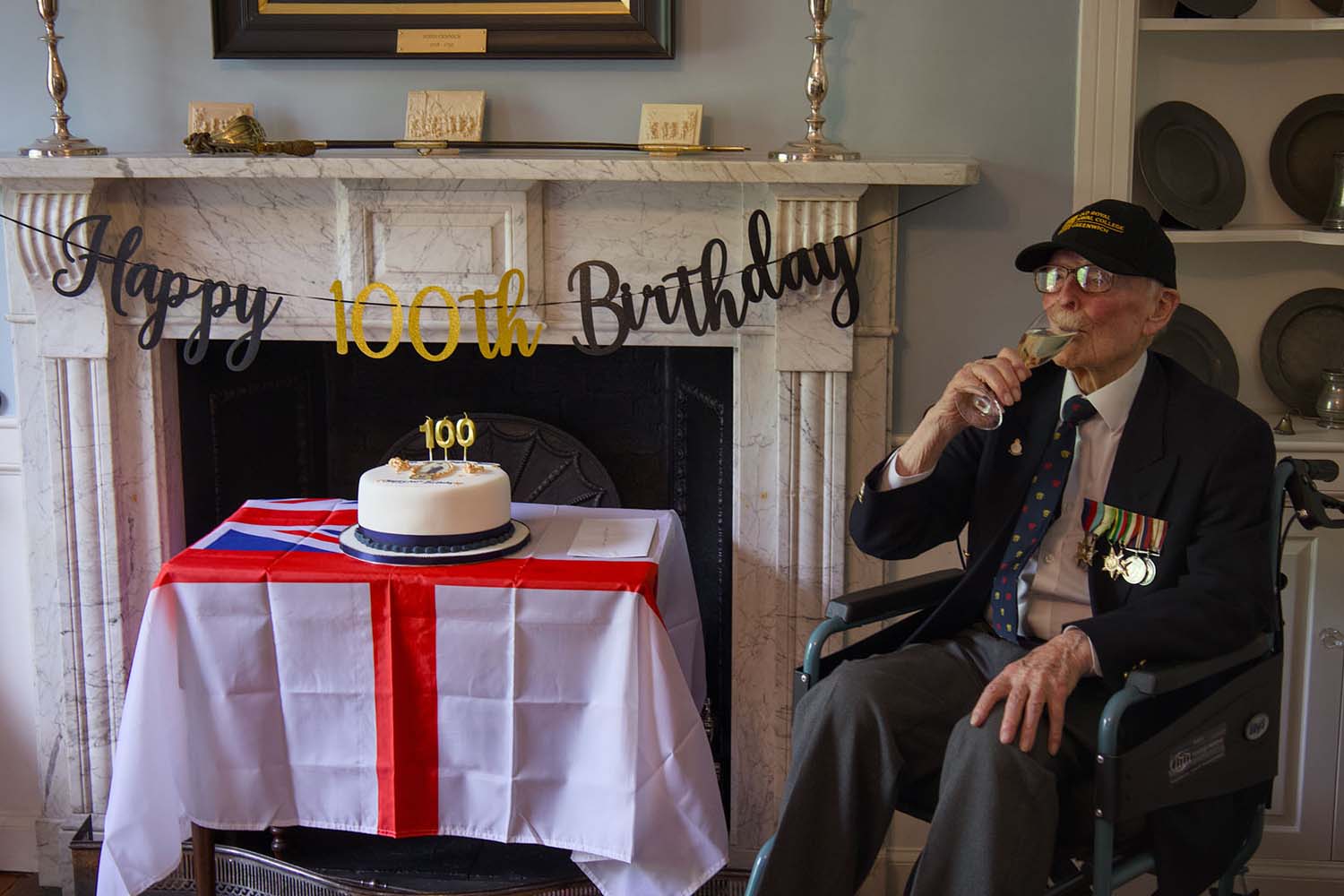
What better way to celebrate a local hero on his 100th birthday than to invite him to open a new path of peace in his hometown.
George Spencer is one of Northern Ireland’s last D-Day and WW2 veterans, seeing extensive action in the Mediterranean, home waters and finally the Pacific – an eventful beginning to a naval career spanning four decades.
To mark his milestone birthday, the retired officer was invited to open the Castle Walk at Gracehill, a UNESCO World Heritage Site near Ballymena, County Antrim, where he has lived with his family since retirement in 1989.
Joining him for the occasion were local dignitaries, national politicians, RN personnel led by the Senior Naval Officer Northern Ireland Commander Thomas Wardley QARNNS, and family and friends.
“It is an absolute privilege to be in Gracehill today on behalf of the Royal Navy to wish Lt Cdr George Spencer a happy 100th Birthday,” Commander Wardley told those present.
“It is an honour to spend the afternoon with George as he cuts the ribbon opening the Castle Walk in Gracehill and celebrating 100 years 'Not Out' – I'm very sure CB Fry would be extremely pleased with him!”
Which may need a little explanation: in 1938, a young George Spencer won a scholarship to TS Mercury a school/training ship based on the River Hamble between Portsmouth and Southampton.
Over the next four years under the direction of Charles ‘CB’ Fry – England footballer and cricketer, athlete, writer and scholar – he was prepared for service in the Royal Navy which he joined aged 16 in 1942 as a Boy Leading Seaman.
Drafted to battleship HMS Nelson, George Spencer was thrust immediately into great events: the invasion of Sicily followed by the surrender of the Italian Fleet to the Allied Commander-in-Chief – and future American President – General Eisenhower in Malta’s Grand Harbour.
He remained with Nelson for Operation Neptune, when the battleship’s 16in guns pounded German defences during the opening minutes of the invasion of Normandy; during the bombardment, the then Boy Leading Seaman, served as an aircraft lookout – although the Luftwaffe was largely absent on D-Day.
Nelson was subsequently damaged by an acoustic mine and sent to the USA for repair, while George was transferred to the Pacific for the remainder of WW2, serving on board former liner HMS Montclare. turned into a depot ship for destroyers.
He stayed in the post-war Royal Navy, earned a commission and served around the globe (his career spanned 28 vessels in all), including Northern Ireland where he met his future wife Jane, a secondment to the Royal Australian Navy and three years as First Lieutenant of HMS St Angelo.
When he returned to the UK, he completed a course on nuclear reactor safety at the Royal Naval College in Greenwich and went on to be Staff Officer Operations in the Clyde before leaving the Service in 1971 as a lieutenant commander.
Thereafter the family moved to Mrs Spencer’s homeland and following a new career in hospital administration, George Spencer retired a second time, settling in the historic community of Gracehill.
Delighted by his birthday surprise – there was a more traditional party with cake back home afterwards – the centenarian thanked those present, especially the Senior Service attendees.
“The Royal Navy means a lot to me. I have fond memories of my long naval career, and I am proud of my service.”
Direct from the front-line, the official newspaper of the Royal Navy, Navy News, brings you the latest news, features and award winning photos every month.