Navy News
Direct from the front-line, the official newspaper of the Royal Navy, Navy News, brings you the latest news, features and award winning photos every month.
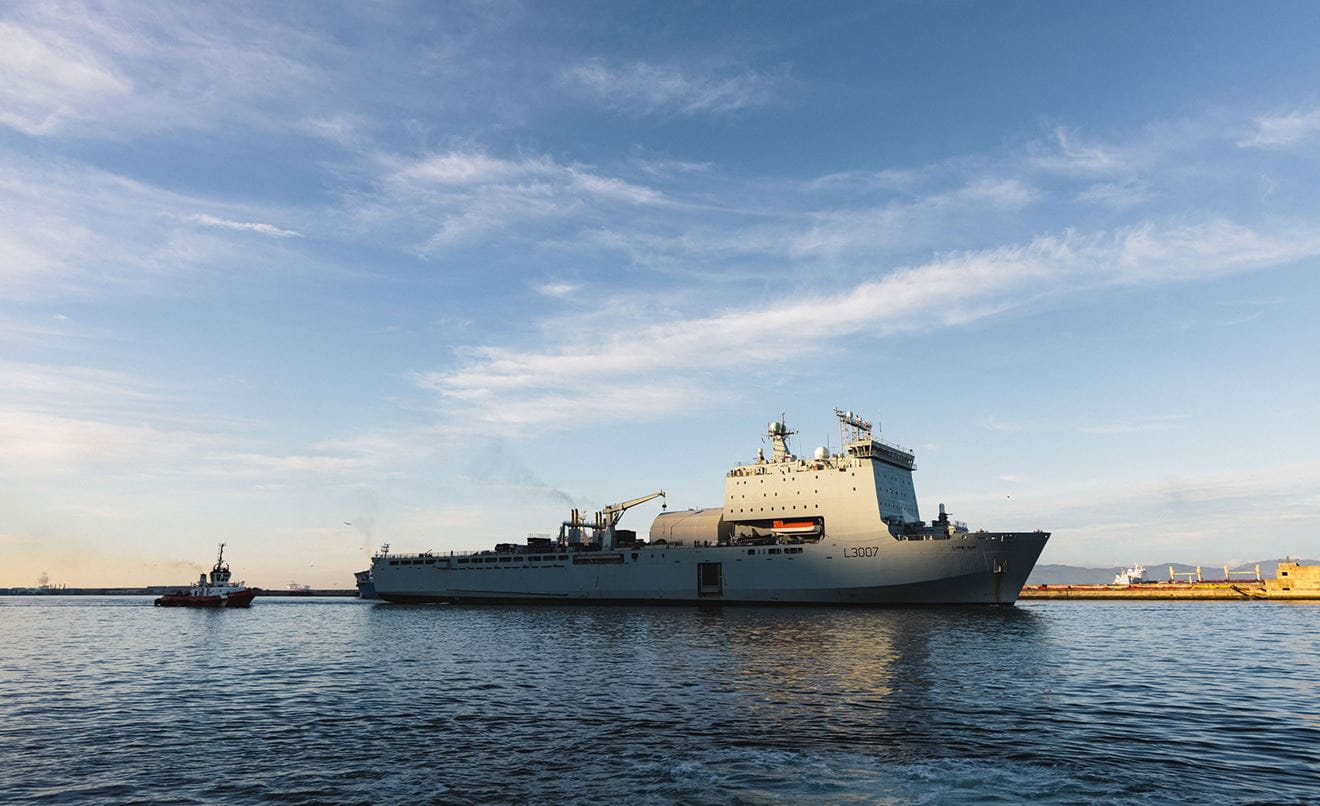
The Royal Fleet Auxiliary ship is preparing to be the minehunting mothership for this cutting-edge technology and play a central role of any future multinational effort to secure the critical waterway and safeguard freedom of navigation.
She sailed from Gibraltar today with more than 100 expert minehunting personnel from the Royal Navy’s Diving and Threat Exploitation Group (DTXG) and Mine and Threat Exploitation Group (MTXG) on board to operate the array of vessels.
It comes after the Government announced earlier this year that Lyme Bay would be brought to heightened readiness and then act as a mothership as the Royal Navy steps up its minehunting capabilities.
All of the technology loaded onto the Bay-class ship has undergone thorough testing and trials in the UK and some has been used in various exercises around the world, proving its ability to operate in various waters and climates.
Commander Dan Herridge, Commanding Officer of MTXG, said: “Personnel from MTXG will embark in RFA Lyme Bay with a clear purpose: to deliver a credible, modern Mine Countermeasures capability.
“Enabled by the Minehunting Capability Programme, they will employ cutting-edge sensors delivered through autonomy and AI to detect threats to the maritime community in some of the world’s most challenging environments.
“Working closely with specialists from DTXG, these threats will be neutralised. This deployment reflects a significant, collective effort from across the enterprise bringing together people, platforms and technology at short notice to field an effect modern capability and ensure the Royal Navy remains ready to counter evolving maritime threats.”
We will employ cutting-edge sensors delivered through autonomy and AI to detect threats to the maritime community in some of the world’s most challenging environments... These threats will be neutralised
The kit includes 12-metre uncrewed surface vessel RNMB (Royal Navy Motor Boat) Ariadne which is a cutting-edge vessel designed to detect and destroy sea mines without the need for personnel to enter deadly minefields.
Other equipment on board will be a multi-role crewless boat which can deploy Seacat – an autonomous underwater vehicle that can produce a detailed 2D or 3D sonar picture of the seabed and uncrewed underwater vehicle (UUV) Remus which can survey the seabed.
Getting the equipment from the UK to Lyme Bay has seen personnel work around the clock from trialling new technologies to strengthen capabilities to drawing on previous experience to adapt them for possible new operations.
Many of the 100 personnel have also operated in the Middle East on traditional minehunting ships so have knowledge and experience that prove crucial to operating in challenging environments.
RFA Lyme Bay’s potential deployment to the Gulf with advanced uncrewed minehunting systems is demonstrative of a shift towards agile, high-tech maritime capabilities. The mission showcases rapid deployment of innovation, developed with UK industry in partnership by Royal Navy and National Armaments Director teams, to secure vital shipping lanes and strengthen defences against evolving maritime threats.
Rear Admiral Philip Game, Director Operations, NAD Plans and Portfolio, said: “We are working alongside British industry to deliver advanced autonomous capabilities directly to the front line.
“This mission is not just a temporary crisis response; it reflects our role as a trusted advisor and strategic partner, deploying UK tech to protect global commerce and reinforce our long-standing security commitments in the Gulf."
As well as the extensive mine warfare equipment and systems loaded aboard the auxiliary, Lyme Bay has also undergone a thorough cyber check to ensure she and those aboard are protected from digital spies and hackers ahead of her mission.
Experts from Royal Navy Digital’s Maritime C5i Support Unit (MCSU) conducted an assessment of the support ship’s IT and personal electronic devices – mobile phones, tablets, smart watches and the like – while she was in Gibraltar.
The team identified both areas for improvement and areas of strong performance, including effective anti-virus management, strong education and training delivery, and good adherence to the portable electronic device policy.
Direct from the front-line, the official newspaper of the Royal Navy, Navy News, brings you the latest news, features and award winning photos every month.