Navy News
Direct from the front-line, the official newspaper of the Royal Navy, Navy News, brings you the latest news, features and award winning photos every month.
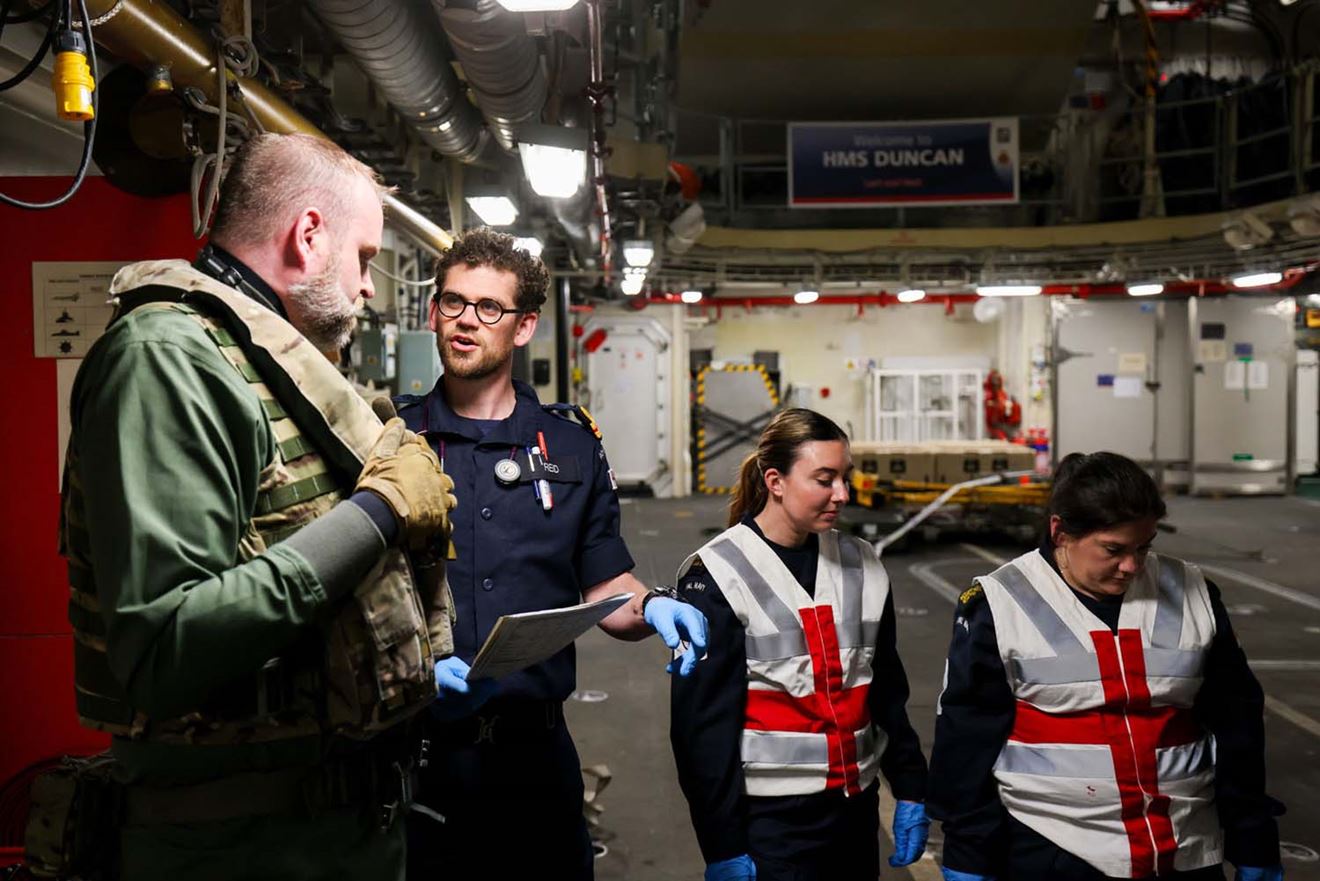
This is the Navy’s ‘air ambulance’ in action in the Norwegian Sea as medics on Britain’s biggest warship tested her ability to help a badly-injured sailor.
It was pressed into service after receiving a ‘999’ from Type 45 destroyer HMS Duncan.
Britain’s two aircraft carriers possess the largest and best medical facilities in the Fleet, including an operating theatre for the most serious wounds/injuries which require immediate treatment; the goal is to treat and stabilise patients so they can be flown ashore for further treatment and recuperation.
But what if you’re not on HMS Prince of Wales or Queen Elizabeth when you suffer a mishap? What if you’re ashore or in another ship in the carrier’s task group.
For that a carrier scrambles a Merlin helicopter with a team of emergency medical practitioners – the Maritime Medical Emergency Response Team (MMERT).
The helicopter – in this instance a submarine hunting variant from 820 Naval Air Squadron – has been reconfigured for transporting casualties.
With the ‘injury’ of a sailor deep in the bowels of HMS Duncan beyond the capabilities of the destroyer’s own medical team/smaller sickbay, the MMERT was scrambled for its first run-out on the UK’s flagship this year (the medics did work with HMS Somerset at the beginning of spring).
The team comprises an emergency medicine and pre-hospital emergency medicine consultant, paramedic, and critical care transfer nurse, all trained to deliver advanced pre-hospital trauma care in challenging maritime environments to treat, stabilise and transfer critically-ill patients.
Having assessed the casualty once flown on to the destroyer, the medics carefully recovered their patient first to the Merlin, provided critical ‘care’ on the short flight, allowing the team to stabilise and monitor the simulated casualty, preparing them for further treatment.
The exercise formed part of wider training designed to maintain high readiness across HMS Prince of Wales’ carrier group – comprising destroyer Duncan providing air defence, tanker RFA Tidespring providing fuel and supplies – as she begins her Operation Firecrest deployment to Nordic waters.
Direct from the front-line, the official newspaper of the Royal Navy, Navy News, brings you the latest news, features and award winning photos every month.