Navy News
Direct from the front-line, the official newspaper of the Royal Navy, Navy News, brings you the latest news, features and award winning photos every month.
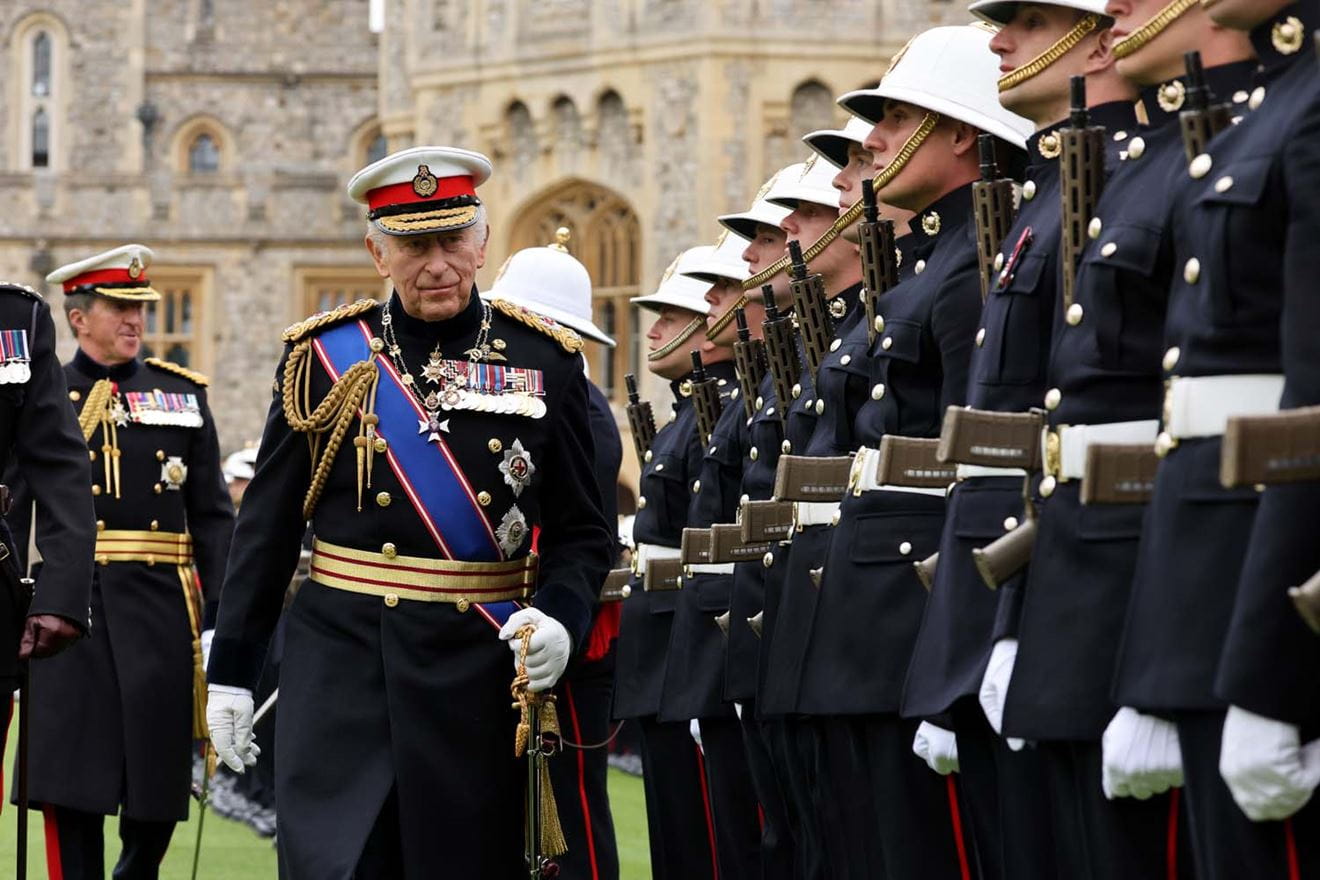
In a historic ceremony at Windsor Castle, sacred flags – bearing the King’s Royal Cypher and touched by his hand – were entrusted to four front-line Royal Marines units: 40, 42, 43 and 45 Commando.
A 56-strong guard of Royal Marines, led by Parade Commander Brigadier Jaimie Norman (commander of the UK Commando Force), unit Commanding Officers, Regimental Sergeant Majors and commandos from each unit, conducted the ceremony accompanied by the Massed Bands of the Royal Marines.
The King’s Colours and Regimental Colours replace those presented 25 years ago by His Majesty’s late mother Queen Elizabeth II and father Prince Phillip, during his 64-year spell as Captain General, a role His Majesty now holds.
First Sea Lord and Commandant General Royal Marines, General Sir Gwyn Jenkins, said: “This is a moment of real historical significance for the Royal Marines. For the first time, four Commando units — 40, 42, 43 and 45 Commando — receive new Colours together, presented by His Majesty The King in his role as Captain General Royal Marines.
“It is a powerful reminder of the enduring bond between the Corps, the Sovereign, and the country we serve.
“These Colours represent more than tradition; they carry the operational history, sacrifice and spirit of the Royal Marines, from our origins in 1664 through to the modern Commando Force.
“While much has changed since the last presentation in 2001, including the transformation into today’s United Kingdom Commando Force, our role at the forefront of national security remains undiminished.
“This ceremony showcases a Corps united by its past and focused firmly on the future.”
The parade formed up at Victoria Barracks, before marching through Windsor to the castle through the George IV Gate.
Under the Old Colours, 74 Royal Marines died on operations in Northern Ireland, Iraq and Afghanistan.
The standards were given an appropriate send-off as they were marched off for the last time before His Majesty, accompanied by General Jenkins, arrived in The Quadrangle, the magnificent ceremonial courtyard that serves as a focal point for royal pageantry at Windsor Castle.
Lieutenant Freddie Williams, in the 40 Commando guard, said: “It just feels like a massive privilege to have been a part of the last 25 years of history of the Royal Marines. There’s been a lot of conflicts and sacrifice, so to be marching off those Colours for the final time is a privilege.”
Following a Royal Salute and the National Anthem, Brigadier Norman marched forward to report to His Majesty and invited him to review the Royal Marines before the new Colours were blessed by Chaplain of the Fleet, The Reverend Doctor Mark Davidson, assisted by chaplains from the four Commando units present at the ceremony.
The consecration of the new Colours, which are draped over a stack of regimental drums, marks their transition from flags to the status of Colours. The drum stack mirrors a tradition in which soldiers would create a sacred space on the battlefield or at their base to hold a service to pray for protection and courage before battle.
The Colours were then presented by His Majesty, who saluted each one, before returning to the dais to address the parade.
A final Royal Salute took place after the Colours were marched back to the formed-up units, followed by a regimental march past and an advance in review order, while the Massed Bands of His Majesty’s Royal Marines struck up the British Grenadiers march.
Lance Corporal Nicola Navan, from the Royal Marines Band Service, said: “I’ve managed to do a couple of parades with the King now and it’s nice to come back and be part of this one today.”
Built on the proud history of the Royal Marines and Commando Forces from World War 2, the modern Commando Force blends the exacting Corps values and the highest standards of soldiering, delivering on operations around the world and continually embracing technological advancements.
Colours are ceremonial flags which traditionally served as rallying points in battle; historically, to lose them to the enemy was regarded as the ultimate shame any regiment or unit could suffer.
Today they continue to be powerful symbols of a unit’s history, achievements and spirit.
Made of silk damask, with gold thread embroidery and a fringe, they bear the names of battle honours and cyphers.
The Colours cannot be used in active duty until they have been consecrated, and while they are no longer carried in battle, the Colours accompany Commando units wherever they are deployed.
The King’s Colour is the Union Flag, with the Fouled Anchor and the reigning Sovereign’s Cypher interlaced in the centre. Above this is the Tudor Crown surmounted by a scroll with the single battle honour ‘Gibraltar’. Underneath is the great globe surrounded by a laurel wreath and below this, a scroll with the Corps motto Per Mare Per Terram.
The cords and tassels are gold, interlaced with the distinguishing colour of the Commando. (40 Commando – light blue, 42 Commando – white, 43 Commando – old gold and scarlet, 45 Commando – red).
The Regimental Colour is a dark blue flag with a small Union Flag at the pike head and the Royal Cypher in the other three corners. This Colour carries similar central embellishments as the King’s Colour, with the exception that the Cypher of George IV replaces that of the reigning monarch. The unit’s numerical designation is shown immediately below the insignia. The cords and tassels are gold, interlaced with the distinguishing colour of the Commando.
Direct from the front-line, the official newspaper of the Royal Navy, Navy News, brings you the latest news, features and award winning photos every month.