Navy News
Direct from the front-line, the official newspaper of the Royal Navy, Navy News, brings you the latest news, features and award winning photos every month.
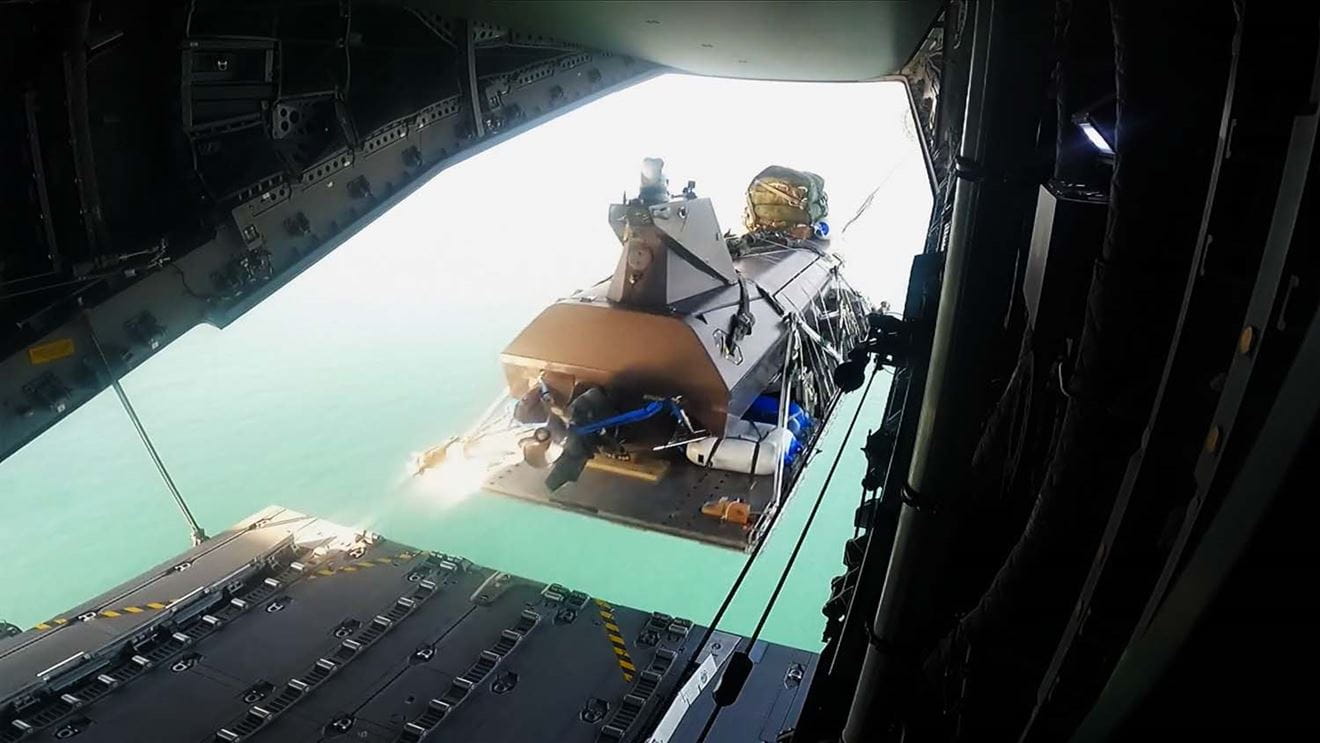
An uncrewed surface vessel was dropped by parachute four times from an A400M at 1,300 feet over the North Sea in the very first extracted-load airdrop of its kind, which was conducted by Kraken Technology Group and Capewell and supported by the Royal Navy under Project Beehive.
These demonstrations across six days proved that a crewless boat can both survive an airdrop and then operate without the need for a support ship or a nearby port – valuable progress as the Royal Navy continues to embrace uncrewed and autonomous technology.
By proving it can be airdropped, it instantly expands the speed, range, and flexibility with which uncrewed maritime capabilities – such as those procured under Project Beehive – can be deployed.
Captain Adam Ballard, who is involved in Project Beehive – which is responsible for bringing emerging technology into service as the Royal Navy looks to deploy a hybrid fleet, said: “Project Beehive was set up to allow the RN to rapidly learn lessons and develop the skills necessary to effectively operate Uncrewed Surface Vessels.
“One of the limitations of small Uncrewed Surface Vehicles is their ability to self-deploy and so we are actively looking at concepts for deployment from motherships or ‘mother aircraft’.
“The recent air dispatch trials that Kraken have conducted show the potential of this capability to rapidly deploy globally."
He added: “Since the earliest aircraft carriers and seaplane tenders we have become accustomed to air power deploying from maritime power. We are now moving to a future where maritime power can be deployed from air power.”
A Beehive-specification Kraken K3 Scout – which can be used for a range of tasks, including surveillance, force protection and precision strikes to name a few – was deployed on Capewell’s Univeral Maritime Craft Aerial Delivery System, a sort of sled to which the craft is attached, and using the Kraken’s optional airdrop kit.
It was then pushed from the plane at 1,300ft into waters up to Sea State 4 with waves of up to 8ft high.
Mal Crease, Founder and CEO of Kraken Technology Group, said: “Working in partnership with Capewell and the Royal Navy, we have demonstrated that K3 Scout can be rapidly deployed directly from a military transport aircraft into contested or difficult-to-access waters ready for operation.
“Kraken alongside Project Beehive will continue to push boundaries to deliver novel and enhanced operational capabilities with our resilient, modular platforms.”
Mark Lavender, Director of Business Development and Training at Capewell said: “In collaboration with Kraken we were able to validate the integration of a complex payload with our UMCADS platform while demonstrating the ease with which the system can be reconfigured for alternative mission essential equipment be they maritime or land applications.
“This was further validated in that we conducted four live airdrops in 6 working days with the same boat and platform during this campaign.”
Direct from the front-line, the official newspaper of the Royal Navy, Navy News, brings you the latest news, features and award winning photos every month.