Navy News
Direct from the front-line, the official newspaper of the Royal Navy, Navy News, brings you the latest news, features and award winning photos every month.
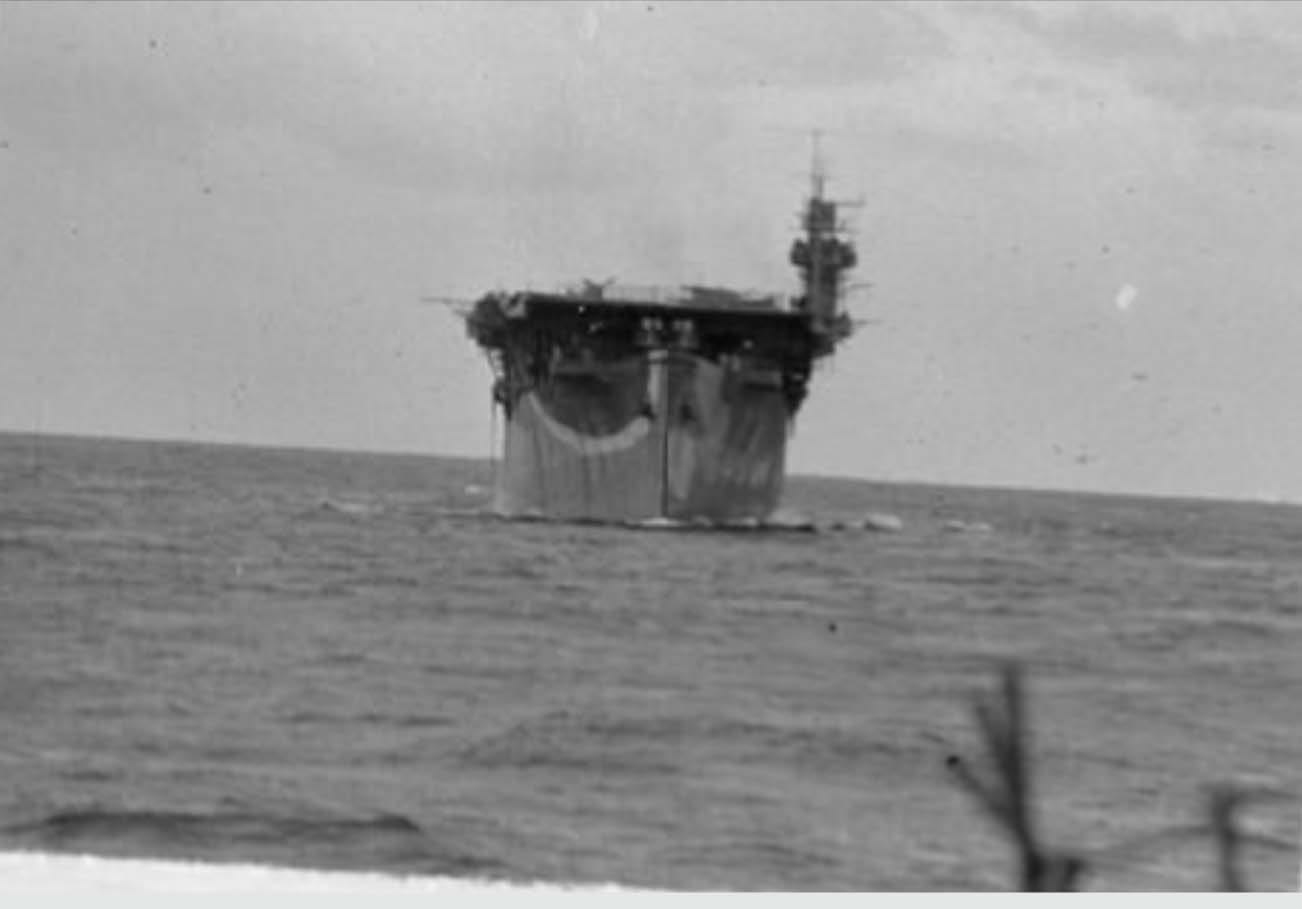
Escort carrier HMS Dasher suffered a cataclysmic explosion and sank in the Firth of Clyde in March 1943 while crew were preparing to support a convoy to the Soviet Union.
But it’s the sailors’ role in another convoy to Russia one month earlier which has belatedly earned her crew the Arctic Star – thanks to evidence gathered by historians.
Dasher was originally built as a merchant ship in the USA, then converted into a ‘escort carrier’ specifically to provide air cover for convoys crossing the Atlantic, embarking up to 15 aircraft.
She’d already escorted Atlantic Convoys and taken part in Operation Torch, the Allied landings in North Africa in November 1942, which helped to spell the death of Axis forces in the desert.
And in the late winter of 1942-43, she was assigned to Convoy JW53 mustering in Iceland to make the voyage around the North Cape. Before departure Dasher’s hull was damaged during a violent storm and she was forced to seek shelter in an Icelandic fjord.
She was sent to Dundee and then Rosyth for repairs, then headed to the Clyde to conduct flying training for the next Arctic convoy.
It’s thought a petrol explosion – caused by a leak/spillage or perhaps a crash on deck – caused Dasher to blow up: 379 of 528 her crew were lost – many escaping the ship went on to die either of burns from petrol from the wreck alight on the surface of the Clyde, or from hypothermia.
Having never sailed to Russia, survivors and descendants were not originally entitled to claim the Arctic Star, which was instituted just over a decade ago following years of campaigning by veterans who argued that the mission and conditions faced were completely different from the Battle of the Atlantic for which they did receive a medal.
Although photographic evidence of Dasher’s accident in Iceland existed, establishing her precise movements and position beyond doubt took some considerable time.
Work by historians/researchers in conjunction with the MOD’s Honours and Ceremonial Branch, has now ensured that members of HMS Dasher’s crew, on board for that duty, qualify for the Arctic Star.
“This positive, and very welcome recognition is now part of the history of this tragic ship,” said Dame Mary Richardson, who was seven when her father George Arthur Habgood, the ship’s butcher, was among the 379 men lost.
“Other than by relatives of the crew and communities in the Firth of Clyde, this loss goes largely unacknowledged and some loved ones died never having been told the facts.”
Dame Mary has campaigned relentlessly for wider recognition of the tragedy, which largely went unnoticed at the time – despite being the second heaviest loss of life in inshore waters between 1939 and 1945.
She and the team of researchers who helped gather the evidence to attain the Arctic Star remain committed to the Dasher story and are keen for any information relating to the ship and her tragic fate: letters, photographs, personal accounts from relatives of crew or eyewitnesses of her loss via [email protected]
Relatives of HMS Dasher’s crew who seek the Arctic Star on behalf of their kin can apply to the MoD Medals Office, Room G36, Innsworth House, Imjin Barracks, Gloucester, GL3 1HW or by emailing [email protected]. The application form is available at: https://www.gov.uk/apply-medal-or-veterans-badge/apply-for-a-medal
Direct from the front-line, the official newspaper of the Royal Navy, Navy News, brings you the latest news, features and award winning photos every month.