Navy News
Direct from the front-line, the official newspaper of the Royal Navy, Navy News, brings you the latest news, features and award winning photos every month.
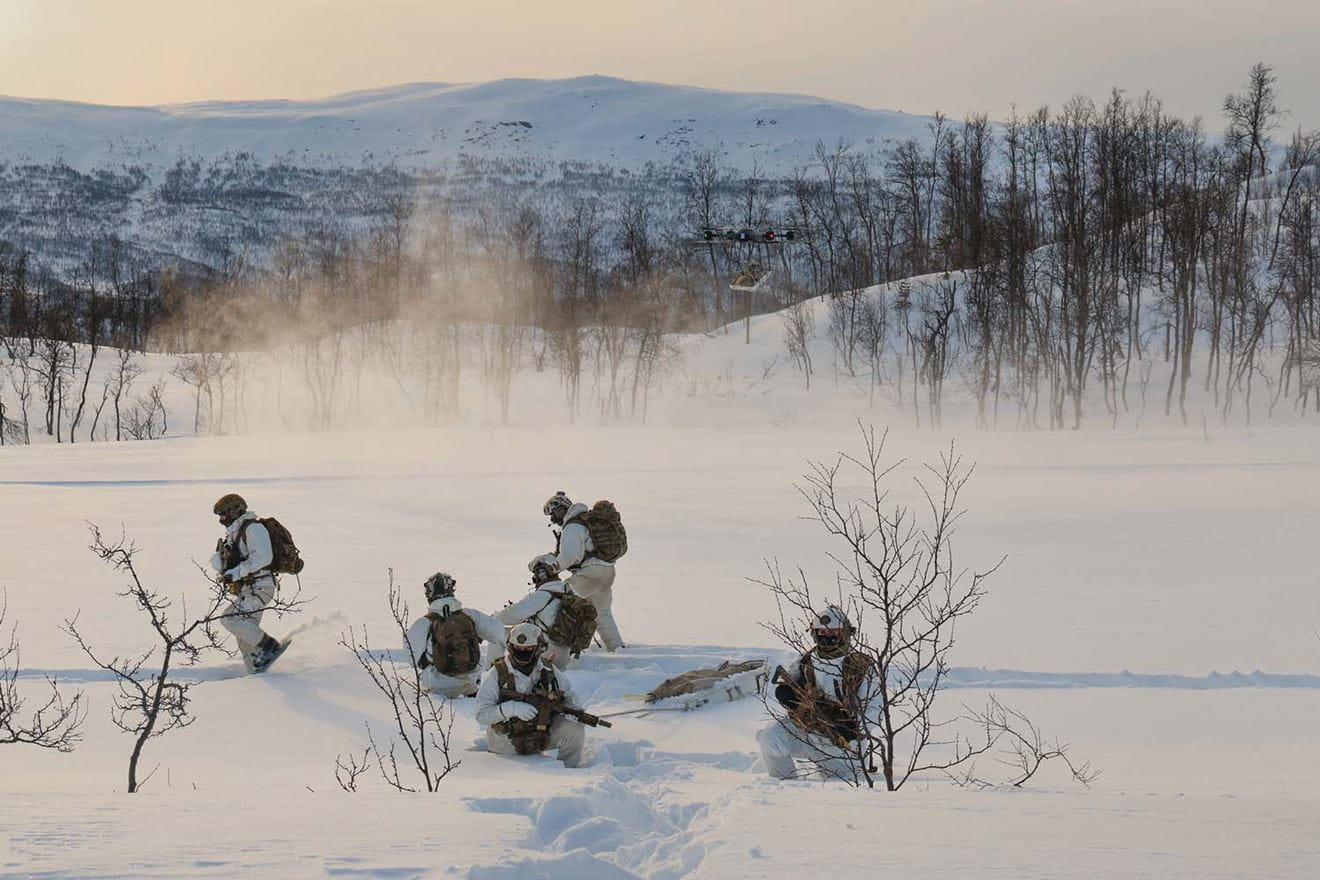
The UK’s Commandos are operating their heavy-lift Malloy Aeronautics T150B quadcopters, primarily used for logistical missions, during their winter deployment to Northern Norway in support of major NATO mission rehearsals in the region.
The marine drone operators of Malloy Flight, Delta Squadron, part of Devon-based Commando Logistic Regiment, have successfully carried out a number of milestone sorties, including transporting 81mm mortars, machine guns, ammunition, blood, and a bomb disposal robot across the battlefield.
These missions strengthen the Commando Force’s ability to fight across the extreme conditions of the Arctic while reducing the need for high-risk, long range ground manoeuvres – relying on the drone to make logistical deliveries instead of navigating across the unforgiving environment in all-terrain vehicles or on skis.
The three-man team have faced temperatures as low as -28c, pushing their machines to the limit as they carried out flights at the Blåtinden Ranges in the Troms region of Norway.
Malloy flight commander, Colour Sergeant Dan Lyness, said: “As the first team to integrate into ground forces in the UK we have been able to bring our experience from working in the UK to the high north and learn to operate with all the challenges of operating in temperatures below zero.
“This is a completely new capability that we are learning to exploit to enable greater movement on the ground with a reduced risk to life leveraging modern technology to our advantage.
“Heavy lift Uncrewed Aerial Systems have been used extensively in the Russia/Ukraine conflict with many new use cases, so it is critical we master this emerging capability quickly, training in the high north is a key part of that.”
The Royal Navy is developing its drone operations as it looks to keep pace with developments seen on the battlefields of Ukraine.
The Malloy T150B, which was declared ready for front-line operations last year after years of rigorous trials, can lift up to 68kg, fly up to 40 minutes and has a top speed of 60mph.
It is designed to carry ammunition, weaponry, food, team and medical supplies to Royal Marines operating in all manner of extreme environments.
The first operational deployment to Norway with the Royal Marines saw Delta Squadron assist mortar troops from 40 and 45 Commando to keep them moving forward without the need to carry their own weaponry.
The Malloy T150 flew the barrel, tripod and base plate for their 81mm mortars to their new firing lines, while also moving ammunition tins.
Fire Support Group from Charlie Company, 40 Commando, also benefitted from the help of the Malloys, with their General-Purpose Machine Guns and tripods moved to new positions, taking the burden away from the teams on the ground.
The drone operators also passed on critical knowledge of how to load and receive cargos from the drones, making future operations more seamless.
Added to that, a bomb disposal robot was flown to location, again freeing up the logistical burden.
Malloy Flight, made up of LCpl Will Cole, Colour Sergeant Lyness and Sergeant Ben Sykes, also helped medics develop tactics and procedures for flying blood boxes and medical packs to the front-line.
Coupled with these successes in the field, the drone operators worked closely with allies, mostly from Norway and the United States, to share tactical knowledge.
They also gave a brief to the Defence Secretary John Healey and 24 MPs from the parliamentary group, as well as defence seniors and commanders.
The Royal Marines Uncrewed Aerial System branch, currently 63-strong, work at Royal Navy Air Station Culdrose in Cornwall. They are assured by 700X Naval Air Squadron to operate and maintain their drones, before being sent out on deployments where they are needed.
700X are the Royal Navy’s drone experts and, last year, successfully made deliveries between warships during HMS Prince of Wales’ major Carrier Strike Group 25 global mission.
They are playing a central role as the UK looks to equip its aircraft carriers with hybrid air wings, combing fast jets, long-range weapons and a range of advanced drones.
Direct from the front-line, the official newspaper of the Royal Navy, Navy News, brings you the latest news, features and award winning photos every month.