Navy News
Direct from the front-line, the official newspaper of the Royal Navy, Navy News, brings you the latest news, features and award winning photos every month.
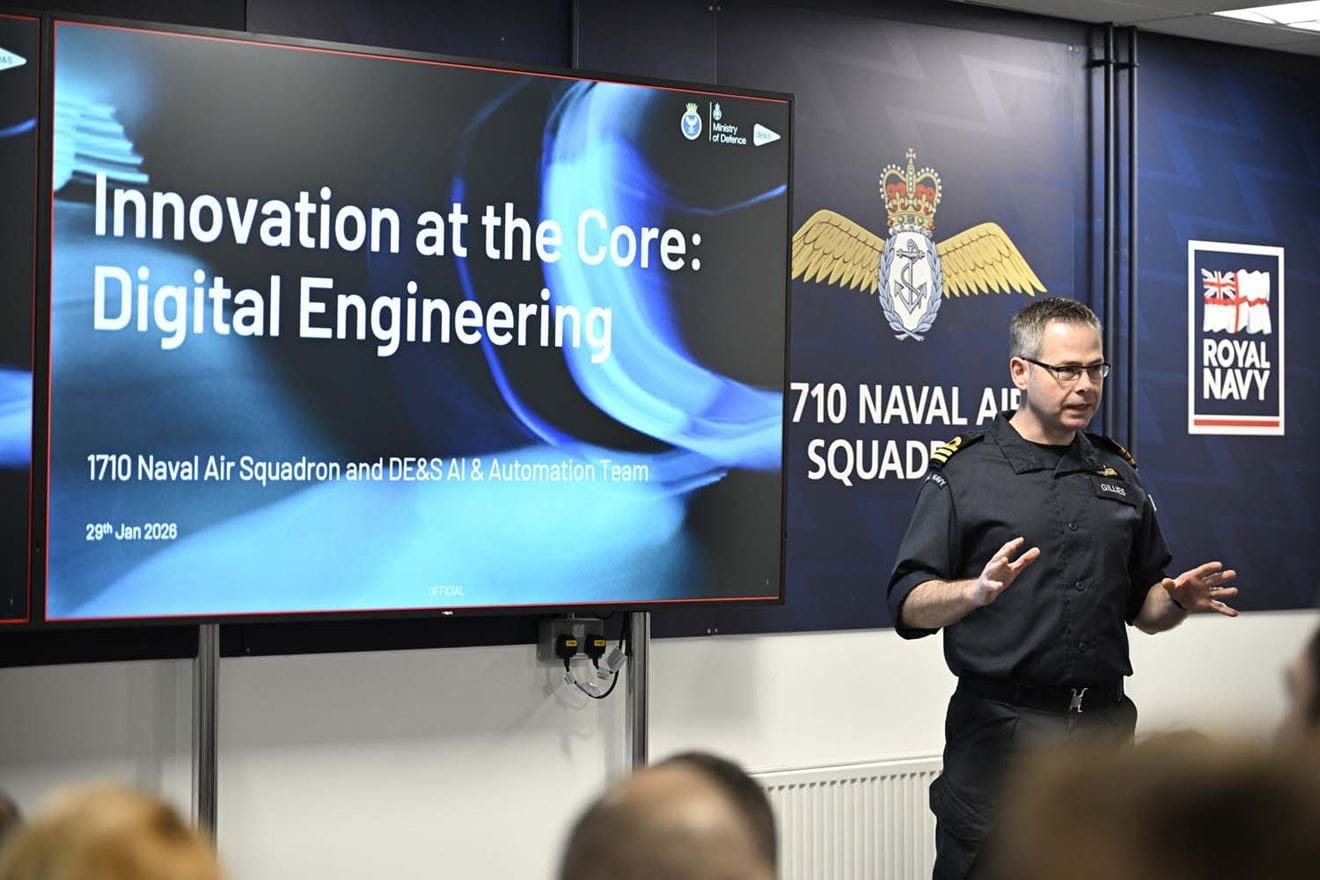
The Royal Navy’s 1710 Naval Air Squadron and Defence Equipment & Support’s (DE&S) Automation and AI team have unveiled a major step forward with the re-launch of the AI enabled Motherlode application.
The enhanced version was revealed at the Squadron’s ‘Innovation at the Core’ event held at HMNB Portsmouth, attended by more than 100 personnel from across the three Services, DE&S, Defence Digital, Navy Digital & AI, Commercial X and industry.
The event focused on accelerating innovation directly into the hands of the warfighter, a theme reinforced by the First Sea Lord in his virtual opening address.
Speaking to delegates, the First Sea Lord General Sir Gwyn Jenkins emphasised that innovation was now a warfighting necessity, noting the pace of technological change and the need for the Royal Navy to learn faster than its opponents.
He urged the Service to focus not on “innovation at the edge”, but on "innovation at the core”, delivering practical capability to frontline users at speed.
The centrepiece of the day was the official launch of Motherlode Version 3, a rebuilt and AI-enabled version of the Fleet Air Arm’s maintenance analytics tool.
The platform provides squadron engineers, Continuing Airworthiness Management Organisations and delivery teams with access to aircraft data, predictive analytics and real time, plain language explanation of complex information.
During demonstrations, the team showed how Motherlode could;
We are giving maintainers the data, context and confidence they need to make rapid, informed decisions.
Lieutenant Commander Sam Budd, from 1710 NAS, said: “This is exactly what innovation at the core looks like.
“We are giving maintainers the data, context and confidence they need to make rapid, informed decisions.
“It has the potential to improve aircraft availability, ease workforce pressure and strengthen our operational output across the Fleet Air Arm, and wider defence.”
Motherlode V3 is now expanding beyond Merlin, Wildcat, Apache, Chinook helicopters to include Poseidon, Wedgetail and Protector aircraft in 2026.
The event also hosted practical demonstrations of emerging technologies supporting defence aviation, including 3D metallic additive manufacturing, 3D scanning for rapid assessment and repair, AI enabled synthetic training environments, Motion amplification diagnostics, Advanced vibration anomaly detection tooling, and Motherlode live demonstrations.
The hands-on sessions allowed frontline maintainers, delivery teams and engineers to directly engage with tools designed to reduce workload, shorten timelines and improve operational resilience.
The event demonstrated the Royal Navy’s growing momentum in applying digital engineering, AI and data driven insight to real operational challenges.
Direct from the front-line, the official newspaper of the Royal Navy, Navy News, brings you the latest news, features and award winning photos every month.