Navy News
Direct from the front-line, the official newspaper of the Royal Navy, Navy News, brings you the latest news, features and award winning photos every month.
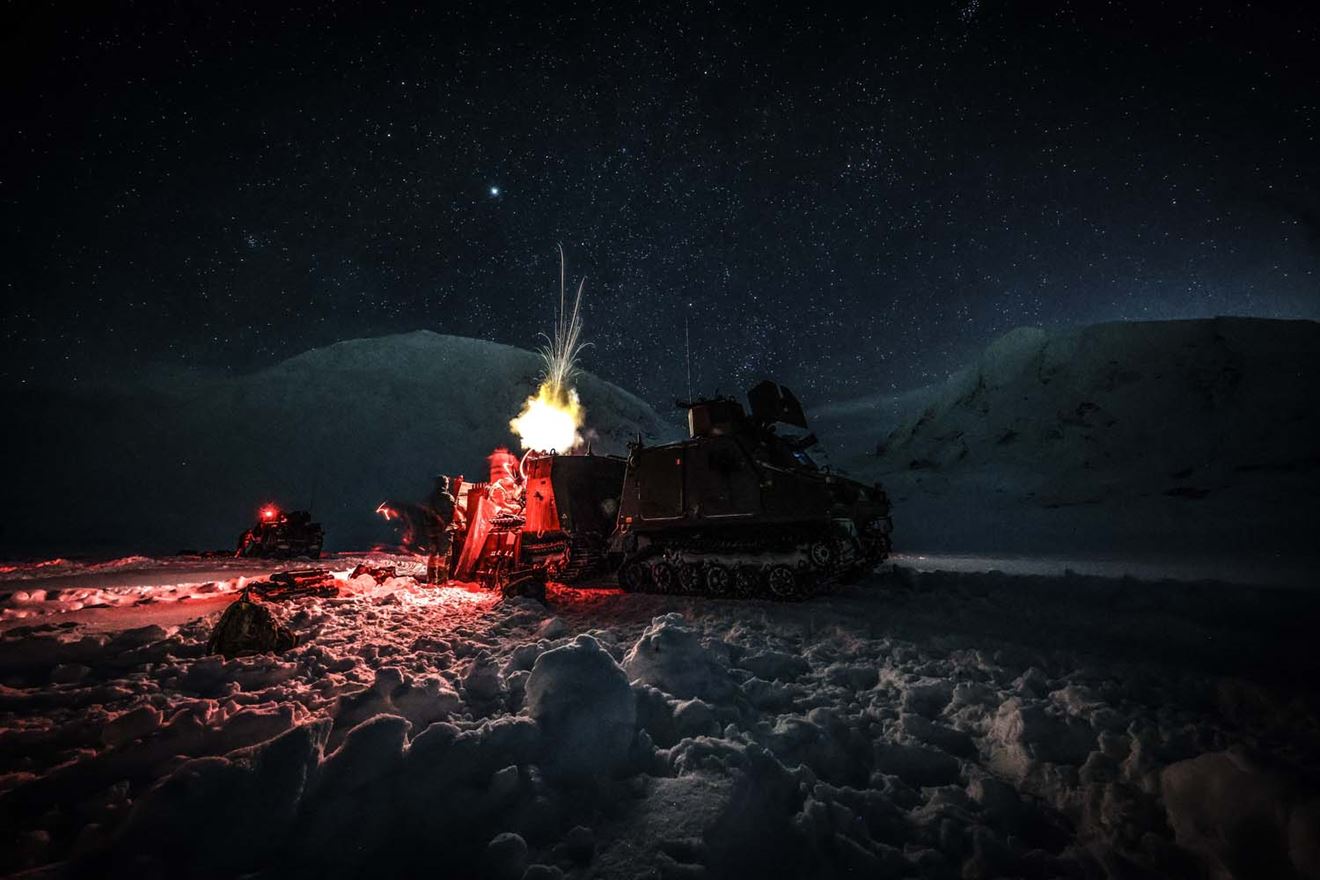
The UK has deployed some 1,500 of its elite Commandos to the Arctic Circle as part of major NATO efforts on its northern flank aimed at the protection of the alliance’s Nordic nations.
As UK Defence Secretary, John Healey, announced bolstered British efforts in the region on a visit to the UK’s Camp Viking in Øverbygd, marines headed to the mountains near the village of Moen – 200 plus miles inside the Arctic Circle – to fire their mortar weaponry.
The Commando Forces’ 81mm mortars can bring around 15 shells a minute raining down on enemy positions, the rounds leaving the barrel at around 500mph and landing on targets up to 3½ miles away.
The mortar troops delivered their fire from Viking and BV206 all-terrain vehicles, practising critical combat skills in sub-zero conditions in some of the world’s most unforgiving environments.
All of this builds up to Cold Response 26 (9-19 March) – NATO’s largest Arctic military drill this year, focused on the defence of the region in the event of an invasion, which will see some 25,000 troops from 14 nations operating together across northern Norway and Finland.
This comes as plans are being laid for Britain to step up its presence in the region, strengthening Arctic and High North security against rising Russian threats.
The Defence Secretary is also expected to confirm that UK Armed Forces will play their part in NATO’s Arctic Sentry mission, with detailed military planning at NATO under way. It comes as the UK-led Joint Expeditionary Force (JEF) confirms major military activity in the High North later this year.
Taking place in September 2026, Exercise Lion Protector will see air, land, and naval forces from JEF nations train to protect critical national infrastructure from attacks and sabotage and enhance their joint command and control capabilities.
John Healey said: “Demands on defence are rising, and Russia poses the greatest threat to Arctic and High North security that we have seen since the Cold War. We see Putin rapidly re-establishing military presence in the region, including reopening old Cold War bases.
“The UK is stepping up to protect the Arctic and High North – doubling the number of troops we have in Norway and scaling up joint exercises with NATO allies.
“Cold Response and Lion Protector will this year see thousands of troops deploy across the Arctic and North Atlantic – with the UK leading the way. We train together, we deter together, and if necessary, we will fight together.”
The Commandos spent a week firing their mortars day and night, honing their accuracy with an array of ordnance in temperatures close to -20c.
They used their all-terrain vehicles as a platform to launch salvos from, but also to quickly move across the deep snow from one location to another rapidly, evading an adversary and, in theory, keeping the Commando Force moving towards their mission objectives.
Mortars have been a staple of warfare for centuries and they still remain a highly dynamic weapon, which can quickly bring fire support to advancing troops on the frontline.
But they can be vulnerable to increasingly powerful enemy radars which can track them down, prompting a counter-barrage to destroy them if they are too static.
The use of the Vikings and other lightweight vehicles keep commandos on the move, allowing mortars troops to maintain vital fire support to comrades before rapidly shifting position and setting up again.
Direct from the front-line, the official newspaper of the Royal Navy, Navy News, brings you the latest news, features and award winning photos every month.