Navy News
Direct from the front-line, the official newspaper of the Royal Navy, Navy News, brings you the latest news, features and award winning photos every month.
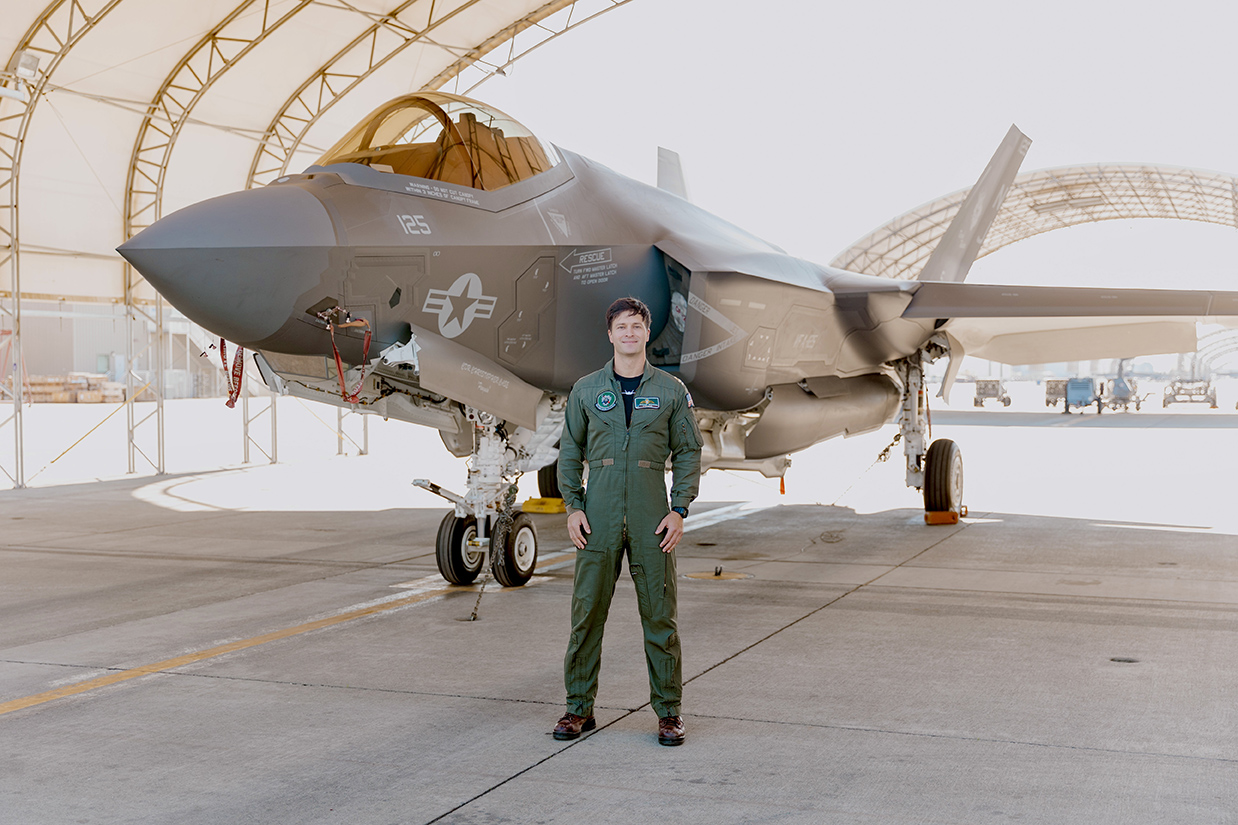
Lt Richard Woods is the first British pilot to serve as an instructor pilot on the F-35C variant and is also the first to be embedded within a US Navy F-35C squadron.
Lt Woods, who grew up in Ashtead, Surrey, volunteered for a non-reciprocal exchange to NAS Lemoore, California, where he’s been stationed since late 2023. At VFA-125, he instructs both ab initio US Navy and Marine Corps pilots, as well as experienced pilots training to become squadron instructors.
Lt Woods said, “This level of joint training and integration between the F-35 partner nations at the tactical and operational level is essential. It’s needed to drive the ultimate objective of multi-national compatibility and integration in theatre.”
This is not Lt Woods first experience of working alongside his American counterparts. Upon completion of Basic Fast Jet Training, flying the Tucano at RAF Linton-on-Ouse with 72 Squadron, he was picked up for his first exchange.In 2018, he moved to Meridian, Mississippi.
While flying the T-45, Lt Woods carrier qualified, landing on the USS Dwight D. Eisenhower. At this point, he earned his United States gold wings, becoming a “Tailhooker”.
Eighteen months later, he moved to NAS Oceana, Virginia to convert to type on the F/A-18 with VFA-106, the “Rhino” Fleet Replenishment Squadron.
Lt Woods joined his front-line squadron, VFA-211, flying the F/A-18E, in September 2020.
After a workup with the squadron, including events at NAS Fallon under the watchful eye of TOPGUN, he deployed onboard the USS Harry S. Truman to the Mediterranean.
During this deployment, the invasion of Ukraine made NATO strength in the region more important than ever.
Lt Woods was frequently entrusted as the ships Defensive Counter Air alert lead, ready to launch and defend the Carrier Strike Group at a moment’s notice.
By training together, we ensure that we’re ready to stand together, if the time arises.
Armed with AIM-120, AIM-9X and the Rhinos 20mm Vulcan cannon, Lt Woods also flew Enhanced Air Patrol over Romania, deterring Russian aggression in the region and proving NATO’s Article 5 resolve.
During the deployment, Lt Woods also integrated with Royal Air Force aircraft out of Cyprus, executing Dissimilar Air Combat Training, where he engaged RAF Typhoon aircraft up close in his Rhino.
Lt Woods also spent several weeks training with Spanish Typhoons. During a detachment to Seville, he instructed some of Spain’s front-line pilots in 1v1 and 2v1 Fighter Manoeuvering.
He said, “One of my most memorable exercises during deployment was leading a training sortie with Greek F-16s. We executed Defensive Counter Air from the USS Harry S. Truman, while Greek F-16s acted as the aggressors. All of it was to the incredible backdrop of the snow-covered mountain peaks of Crete.”
On completion of his front-line tour, and with almost 300 carrier deck landings under his belt, Lt Woods joined VFA-125. The F-35C is the USN’s latest and greatest 5th generation stealth fighter, with proven capability not only now, but with expandability for years to come.
The F-35C variant differs from the A and B variant. The most obvious feature is its larger wingspan. The larger wing means that it can fly at slower speeds, critical for catapult launches “cats” and arresting cable landings “traps” at the ship.
The large wings also mean that the F-35C can hold more fuel than its A and B cousins. Other modifications include a tail hook, beefed up landing gear for carrier deck landings and folding wings to fit into the limited space onboard the aircraft carrier.
Not only is Lt Woods an instructor at VFA-125, but as the Assistant Operations Officer, he’s also responsible for planning and managing training on the huge United States Navy squadron. This job involves liaising between VFA-125s maintenance and training departments as well as managing the squadron's range space.
When he completed officer training at Britannia Royal Naval College in 2014, Lt Woods could never have imagined how far the first decade of his career would take him.
He has this advice for any aspiring jet pilots: “Work hard and never give up. Stay focused working towards each objective along the way, but don’t lose sight of what you’re trying to achieve.
“It doesn’t happen overnight, but you’ll get there if you persevere.”
He hopes more RN pilots will have the opportunity to follow his lead, working alongside the UK’s F-35 partners, for years to come.
“By training together, we ensure that we’re ready to stand together, if the time arises.”
Direct from the front-line, the official newspaper of the Royal Navy, Navy News, brings you the latest news, features and award winning photos every month.