Navy News
Direct from the front-line, the official newspaper of the Royal Navy, Navy News, brings you the latest news, features and award winning photos every month.
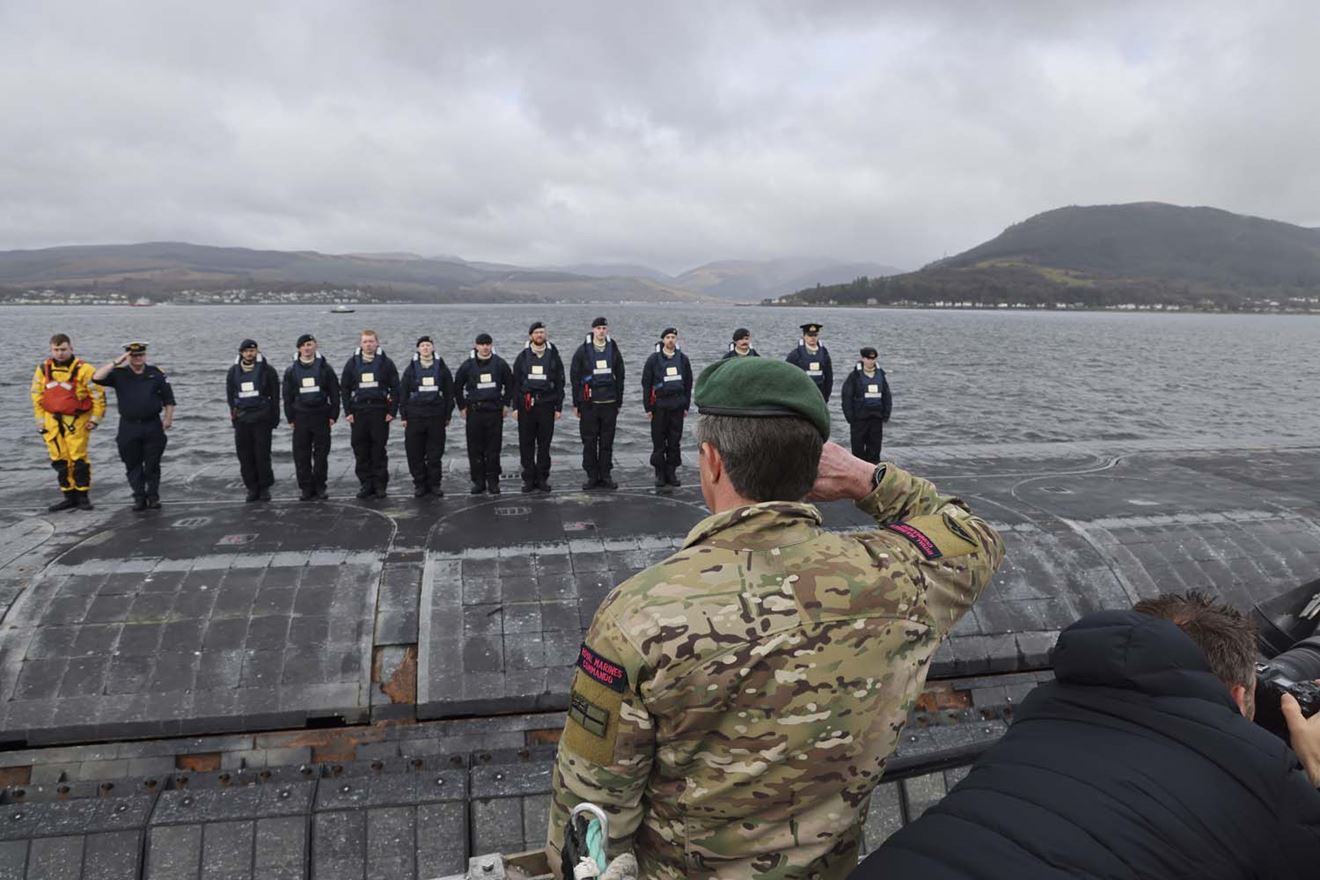
The Royal Navy Vanguard Class submarine and its crew of 140 submariners sailed back to HM Naval Base Clyde and into the arms of family, friends, and loved ones who were excitedly awaiting their arrival.
Among those joining the crew in the final part of their homeward journey was Prime Minister Sir Keir Starmer, Defence Secretary John Healey, First Sea Lord General Sir Gwyn Jenkins, and Chief of Defence Nuclear Madeline McTernan.
Defence Secretary John Healey MP said: "I am proud to welcome home our dedicated submariners who help to keep the UK and our NATO allies safe from the most extreme threats we face every minute of every day. The crew represents the very best of our Armed Forces and I thank them for their service.
"The families who support them make huge sacrifices to keep this country safe and I am deeply grateful to them all.
"Our UK nuclear deterrent is the ultimate guarantee of our security, and as the threats we face increase, it is more important now than ever.”
The UK’s Continuous At Sea Deterrent ensures that at least one nuclear-powered and armed ballistic missile submarine is always at sea to deter potential adversaries and protect our nation and NATO allies.
It is a mission which the Royal Navy has fulfilled since 1969 when the Resolution Class submarines first took up the mantle. Today, it is the Vanguard Class vessels which deliver the crucial mission.
The Prime Minister was there to thank the submariners for their dedication and commitment to defence. Following his visit to the submarine at sea he joined around 400 submariner families and loved ones within HM Naval Base Clyde’s Warrant Officers and Senior Rates Mess.
Among them was Emma whose 22-year-old son was serving onboard the submarine during his first deterrent patrol.
“Probably the most challenging part is not hearing from them during the patrol,” said Emma. “We can send 120-words to him a week, but it is all one-way and the messages are vetted for security reasons. Our family are big Lincoln City F.C. fans so quite a lot of the space is taken up by football scores!”
Emma said that her son was determined to join the Navy from a young age.
“He was a member of a Sea Cadet Unit when he was a boy and they were fantastic. He got to sleep onboard HMS Bristol and got involved in interesting projects like taking an engine apart and reassembling it. It was a great environment, and he decided that the Royal Navy was for him.”
She continued: “The separation is hard, but I have to give credit to the Royal Navy Family and People Support team who have been exceptional. It really helps to know that they are there, and they have kept us informed throughout the deployment, pushing out information, and holding community events such as virtual quiz nights.
“I’m super proud of what he has chosen to do and that he is putting service before self as part of the Submarine Service.”
The Prime Minister’s visit came as the Submarine Service marked its 125th anniversary. Formed in 1901 with the arrival of the Royal Navy’s first submarine “Holland 1”, the service has played a key role in protecting the nation through two World Wars, the Cold War, and conflicts in the Middle East.
During this time the Submarine Service has earned a total of 14 Victoria Crosses, with five awarded during the First World War alone.
Royal Navy submarines provide the UK with unique military capabilities. They can operate undetected and so contribute to intelligence gathering, special operations, and can carry out surprise attacks. They help protect aircraft carriers, hunt other submarines, and can attack land targets, as well as being a deterrent to potential enemies.
While at HM Naval Base Clyde, Sir Keir Starmer, John Healey, and General Sir Gwyn Jenkins also visited Royal Marines from 43 Commando Fleet Protection Group who were on duty to protect the nuclear deterrent.
The elite Marines provide the final line of security to the nuclear submarines based at Faslane, ready at a moment’s notice to react should an enemy attempt to access the deterrent.
"The return from Continuous At-Sea Deterrence patrol is a moment to reflect with pride on the extraordinary dedication of the crew,” said General Sir Gwyn Jenkins, First Sea Lord.
“These highly trained submariners have once again demonstrated the professionalism and resolve that makes the Royal Navy the finest in the world.
“But the strength of our deterrent does not rest with the crew alone. Behind every sailor and submariner is a network of family and friends whose unwavering support makes these long deployments possible. Their sacrifice is quiet, but it is profound, and it is every bit as vital to the security of the United Kingdom as the work carried out beneath the waves.
“To the crew and to all those who stood by them at home, well done. You have served your country with distinction, and the nation is safer for it.”
A new class of ballistic missile submarine – the Dreadnought Class – is currently under construction at Barrow-in-Furness and is expected to replace the Vanguard submarines from the early 2030s.
The government is investing millions of pounds at HM Naval Base Clyde to prepare for the Dreadnought submarines. Last year, the government approved a £270M investment package – an initial three-year funding that will be used to adapt and improve infrastructure at the Clyde base.
Part of the improvements include the construction of four new Single Living Accommodation blocks. The first two, earmarked for Submariner students undertaking training at Clyde’s new Royal Navy Submarine Training Centre (RNSTC), are scheduled to open late this year.
On March 24th, a new training facility extension, which will be used to train RN Submariners operating the Dreadnought submarines, officially opened. The new Trident Training Facility Extension will provide crews, and in particular weapons engineers, with bespoke training using shore-based equipment that exactly replicates that found on board a Dreadnought vessel. It is expected that it will open its doors to the first students later this year.
Direct from the front-line, the official newspaper of the Royal Navy, Navy News, brings you the latest news, features and award winning photos every month.