Navy News
Direct from the front-line, the official newspaper of the Royal Navy, Navy News, brings you the latest news, features and award winning photos every month.
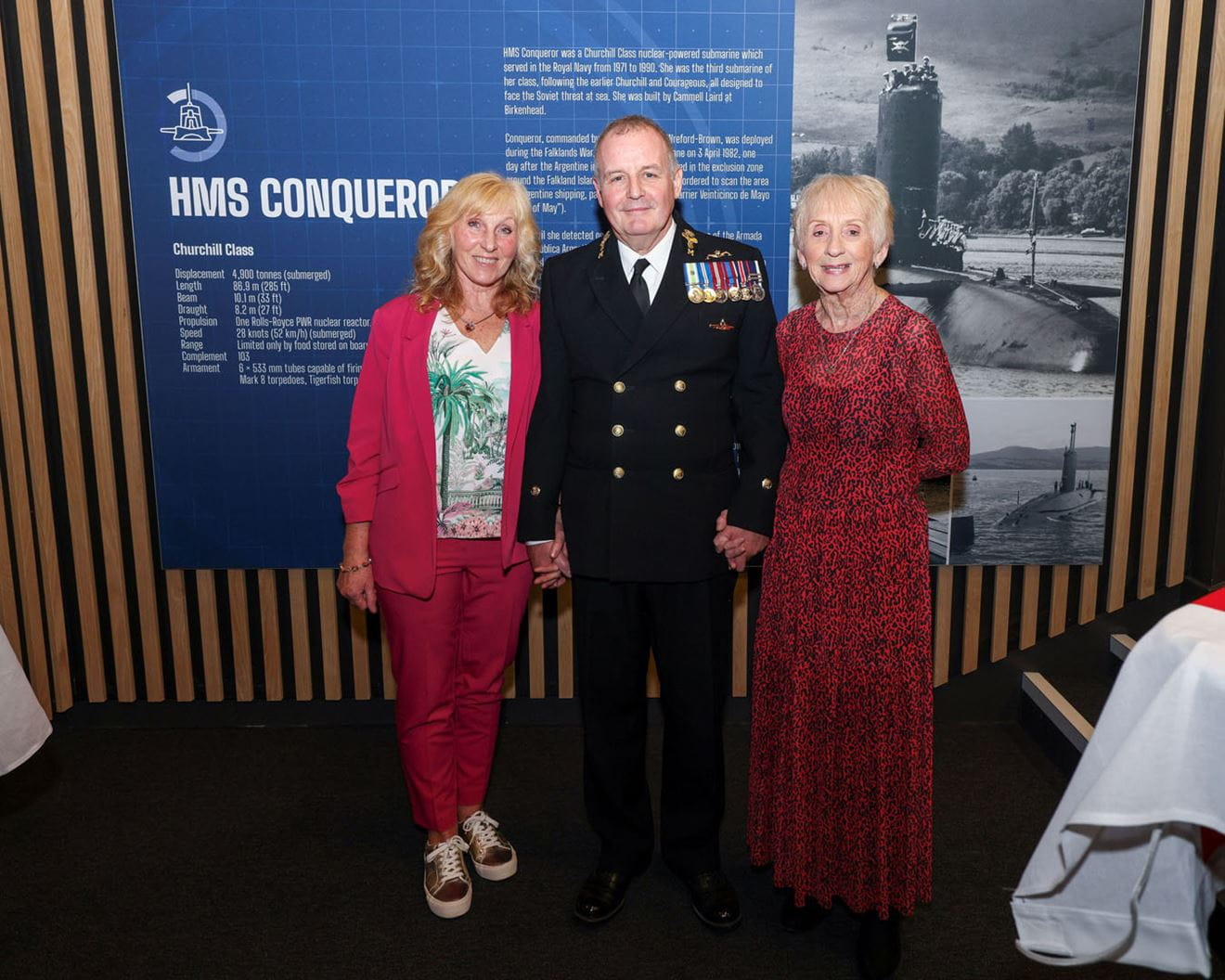
Until formally leaving the Service earlier this week during a fitting ceremony at Faslane, Chief Petty Officer Gary Hutchinson was the last crew member of HMS Conqueror – the submarine which sank the General Belgrano in the opening moves of the campaign to liberate the Falklands – still serving.
Current and trainee submariners filled the HMS Conqueror lecture hall in the new Royal Navy Submarine Training Centre at HM Naval Base Clyde to thank the 64-year-old for his outstanding service to the Navy and nation.
And it fell to Vice Admiral Sir Tim McClement – Conqueror’s Executive Officer in 1982 – to present the senior rating with his golden valedictory certificate, witnessed by Gary’s wife, Deborah – also recognised for the years of sacrifice and separation with a bouquet of flowers – and mother-in-law, Ann.
“It’s the first time we’ve seen one another since the Falklands,” said Admiral Sir Tim said. “It’s astonishing, really. It was his first time onboard a boat. And when I was asked to fly up from Portsmouth to present this award, I leapt at the chance!”
Originally from South Yorkshire, Gary moved to Clacton, Essex, when he was six years old and began his Royal Navy career in November 1979 aged 19.
After completing his basic training, an instructor at HMS Sultan in Gosport convinced him to volunteer for the Submarine Service, and Gary joined his first boat, HMS Conqueror, in 1981 as a Marine Engineer Mechanic (forerunner of today’s ETMEs).
“When I first joined Conqueror, the submarine was berthed on the Admiralty Floating Dock (AFD) 60 in HMNB Clyde,” explained Gary. “And, in 1982, when the Falklands War broke out, we were at HM Naval Base Clyde and deployed from there the day after the Argentinian invasion.
“At the time, I was serving as a control room watchkeeper and was in the Auxiliary Machine Space when we sunk the Belgrano. We worked hard under immense pressure, but, as a young man I treated the whole experience as an adventure.”
I will miss the camaraderie when I retire and being in the Submarine Service community. I have really enjoyed being in the Service and would recommend it to anyone. I originally signed-up for only nine years but have actually completed 46!
Twenty-one days after leaving the Clyde, HMS Conqueror arrived in the exclusion zone around the Falkland Islands. The submarine was ordered to scan the area for Argentinian ships and on April 30 detected an enemy task force sailing towards the exclusion zone.
Fearing a potential “pincer attack”, permission was given for Conqueror to engage the enemy. Launching three Mark 8 torpedoes, the submarine sank the Argentine light cruiser ARA General Belgrano.
Viewed by some as controversial, it was later acknowledged by the Belgrano’s captain and the Argentine government that the sinking was a legitimate act of war. The Argentinian task force had been ordered to seek out the British and launch an attack.
Gary said: “At the time of firing it just felt like regular practice. The crew often trained for fire drills should the occasion arise, and, in this case, it finally did.”
Gary went on to serve on HMS Conqueror on and off for some ten years. Following the decommissioning of the Valiant Class submarines, he was drafted to the then-new Vanguard-class nuclear deterrent boats.
Working with HMS Vanguard in-build, he was part of the crew who brought her out of the shipyard and to sea, later going on to test fire the first UK Trident missile as well as completing the inaugural Trident patrol. He subsequently served with her sister boats HMS Vigilant and Victorious.
“There are clear differences between the Valiant and Vanguard-class boats,” said Gary. “The biggest difference is in the technology. The Valiant boats were more manually operated as opposed to the Vanguards which have a more automated approach. These advancements helped make the newer boats safer and more efficient for the crews who operate them.”
For the past ten years or so, the veteran submariner has worked in HM Naval Base Clyde’s Shiplift. The huge engineering facility can haul a 14,000 tonne Vanguard submarine out of the water to allow essential engineering work and Gary has helped maintain the equipment within the building.
Gary said: “I will miss the camaraderie when I retire and being in the Submarine Service community. I have really enjoyed being in the Service and would recommend it to anyone. When I joined, I originally signed-up for only nine years but have actually completed 46! I am looking forward to the new adventures that retirement will bring.”
The first new adventure is likely to be a trip to a US theme park with his wife and fellow rollercoaster enthusiast, Deborah. The pair are also looking forward to spending more time in the gym, kayaking, paddleboarding and walking their dog.
Director of Submarines Rear Admiral Andrew Perks, who also attended the farewell ceremony, said: “CPO Hutchinson’s remarkable 46-year career has spanned several chapters of the Submarine Service’s history, most notably as the last serving member of HMS Conqueror’s crew from her period of combat operations during the Falkland’s conflict.
“He has exemplified the very best of our Silent Service throughout his career and I wish him and his family all the best as he transitions into a well-earned retirement.”
Direct from the front-line, the official newspaper of the Royal Navy, Navy News, brings you the latest news, features and award winning photos every month.