Navy News
Direct from the front-line, the official newspaper of the Royal Navy, Navy News, brings you the latest news, features and award winning photos every month.
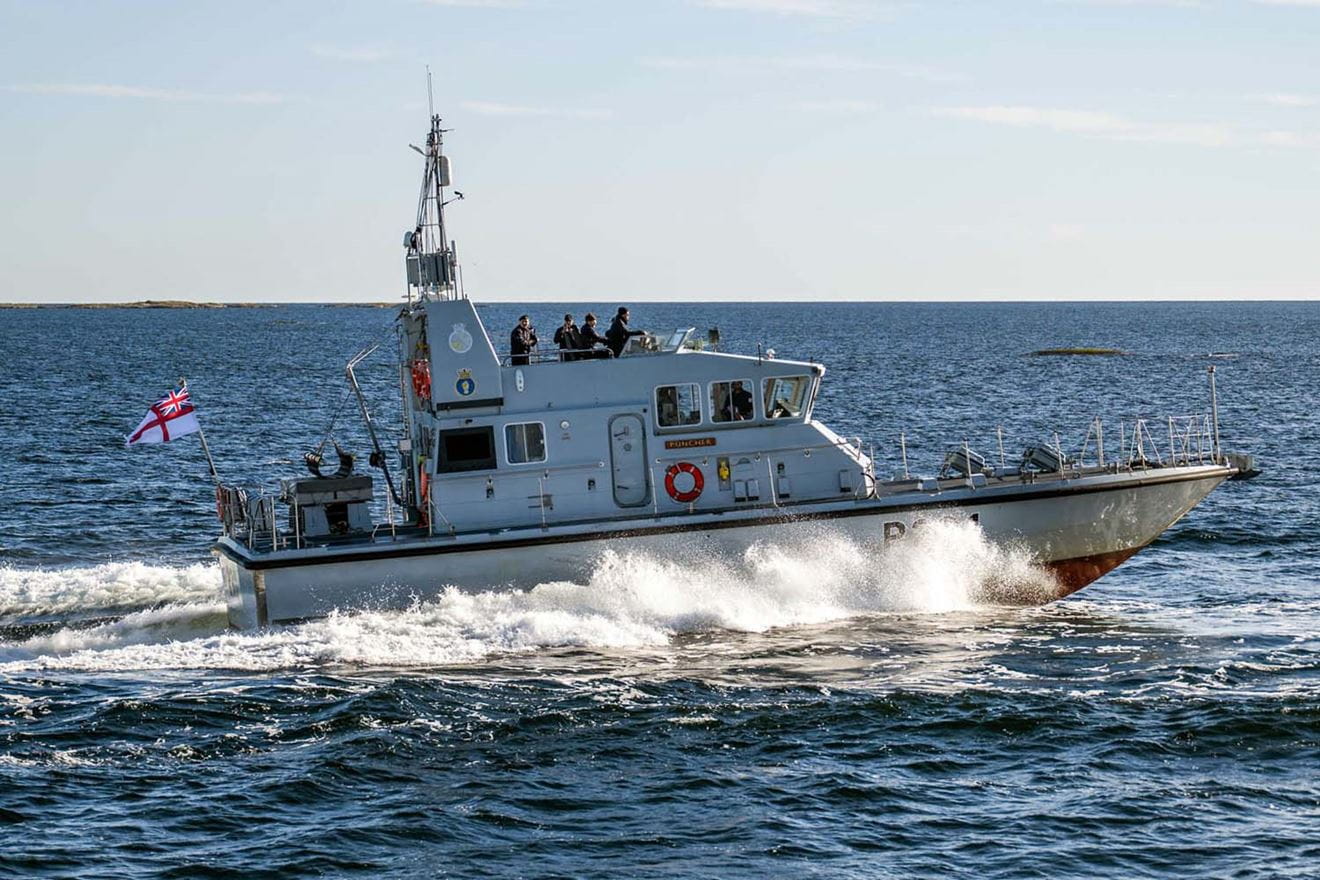
HMS Puncher, Express, Pursuer and Dasher from the Royal Navy’s Coastal Forces Squadron left the UK in August to spend the dying days of summer/early autumn working with allied navies/coast guards from Joint Expeditionary Force nations in the Baltic.
The overarching Exercise Tarassis is the largest military exercise JEF – a coalition of nations committed to the security of northern European waters/countries – has staged by land, sea and air, including amphibious landings by commandos on Norway’s Arctic coast to Royal Marines on the ground in Estonia.
For the Coastal Forces Squadron it has meant a series of exercises with naval forces – principally Latvia, Estonia and, most recently, Finland and Sweden – largely focused on protecting shipping and harbours from attack by fast, agile boats, as embodied by the four P2000 craft.
The final exercise of the deployment took the quartet to Berga Naval Base, 17 miles south of Stockholm, to test their skills against Swedish fast boats.
Smaller than a P2000 (54 rather than 68ft long), half the weight, fast (up to 40 knots powered along by twin jets) and extremely manoeuvrable, the Combat Boat or CB90 requires just three crew (to five on a P2000).
Operated by the marines of the Swedish Amphibious Corps, it was specifically designed for the archipelagos which stretch along the Swedish coast.
In its native waters it is a formidable opponent, as the four British craft discovered as they jostled for position to break through a CB90 ‘ring of steel’ and ‘attack’ a high-value vessel.
The Swedish craft are heavily armed: machine-guns, automated cannon, grenade launchers, even mines or depth charges.
But it was their crews’ ability to use ‘non-lethal force’ which really impressed the P2000s – whose crews took away much to mull over from their participation in Fallex (Fall Exercise) which will benefit future small boat tactics.
“Fallex was the fifth and final exercise as part of our deployment, which has allowed us to develop the coastal warfare concept and learn from the Baltic states, particularly their patrol and harbour protection expertise,” said Lieutenant Keaton Leyland-Jones, Commanding Officer of HMS Puncher.
Given the role the P2000 boats have performed through much of their careers – introducing undergraduates to life in the Navy – the Coastal Forces Squadron’s Commanding Officer, Commander Mark Hayes, is delighted by the vessels’ ever-growing utility supporting front-line operations.
“Tarassis represents the fourth overseas deployment for four or more units from the Coastal Forces Squadron this year,” he said. “It has allowed unparalleled integration with our Joint Expeditionary Force partners. Focussing on harbour defence, P2000s have again proved that they are a capable element as part of a larger joint response option.”
Ahead of Fallex, the British quartet were in Finnish waters working with the other new member of NATO.
The vessels conducted combined training with missile boat FNS Hamina, focused largely on joint communications and getting used to the two navies’ ways of working, before the Brits spent a few days sampling the delights of Helsinki.
“The communication between us has been great and everything has worked like clockwork. I have absolutely no doubt that if the call came for us to work together, we’d be able to do so, really quite easily,” Lieutenant Jack Mason, Dasher’s Commanding Officer, said of working with the Finns.
Direct from the front-line, the official newspaper of the Royal Navy, Navy News, brings you the latest news, features and award winning photos every month.