Navy News
Direct from the front-line, the official newspaper of the Royal Navy, Navy News, brings you the latest news, features and award winning photos every month.
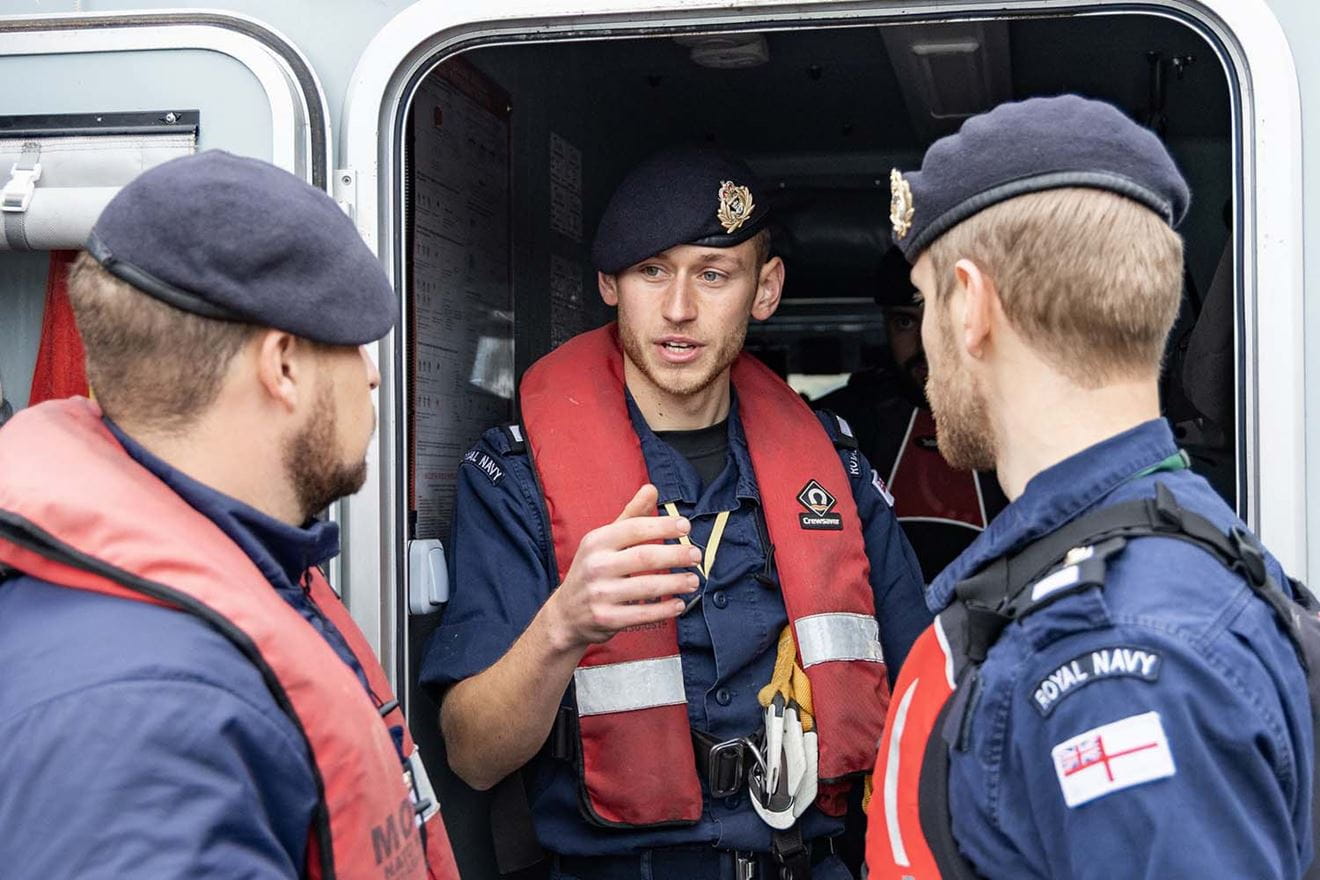
Challenging manoeuvres. Challenging conditions. Pressure. Success.
At the mouth of the River Dart, a winchman is lowered on to the small, bucking, rolling forecastle of HMS Smiter to collect a casualty delivered by Officer Cadets, one of the most visual – and dramatic – serials in the final maritime assessment at Britannia Royal Naval College.
Older officers will remember the MARL exercise, as it was then known, run by the Dartmouth naval college in sluggish old picket boats and smaller skiffs.
Today with faster, manoeuvrable, modern Vahana boats Exercise Final Endeavour has grown considerably, with ‘friends’ regularly dropping in to support the training – and bolster their own.
So that could be an A400M transporter, or RN ribs churning up the Dart estuary, or it could be a Wildcat from Yeovilton and P2000 from along the coast at Devonport.
It allows for some more challenging – and realistic – training and assessment serials, such as a casualty evacuation (CASEVAC).
One constant: it’s relentless, it’s exhausting, it’s pass or fail.
For one serial of the latest Final Endeavour, accident-prone doll Ruth Lee needed to be transferred by the cadets crewing one of the Vahana boats to HMS Smiter for onward transfer to hospital (which bore an uncanny resemblance to Britannia College) by helicopter via a makeshift landing site cleared at Sandquay.
A winchex (winching exercise) is bread-and-butter to aircrew – it’s a mainstay of training and operations, particularly search and rescue.
It’s rarely conducted, however, with a P2000 patrol boat. HMS Smiter doesn’t have the comms and flight-specific equipment larger RN vessels possess to communicate and guide the aircrew.
In addition to size (or lack of it), P2000s move around a lot due to their top-heavy superstructure.
So while planning the casualty evacuation and moving Ruth from a Vahana to Smiter without further injury is a test of planning and seamanship for the Officer Cadets… and the actual evacuation a definite test of sea/airmanship for the Wildcat and P2000’s crew.
“Space on a P2000 is also at a premium which doesn’t leave much room for error on the winchmen’s part,” explained Lieutenant Sam Charleston, Smiter’s Commanding Officer.
“While we do mitigate snagging hazards by removing some upper deck fittings, such as the Jackstaff, the aircrew must work hard to get onto the deck safety.
“P2000s seldom get to practise live winching so this serial provided my ship’s coy with an opportunity to put theory into practice – while demonstrating to the Officer Cadets on exercise what Royal Navy assets can achieve.”
Lieutenant Zoe Jones, Maritime Leadership Training Officer, said including operational assets raised the bar considerably for the cadets, who have not yet been to sea in front-line warship, and expanded the opportunities for their assessment with the exercise running over several days,
“One of the Officer Cadets turned to me as the Wildcat flew over to rendezvous for the winching exercise and told me that they didn’t think that it would be real,” she explained.
“For them to be able to speak to the aircraft for intelligence gathering is all new, let alone embarking a liaison officer on to a P2000, clearing a helicopter landing site and evacuating the ‘casualty’ to Sandquay an hour later.”
Smiter has continued to support Final Endeavour, playing the ‘high value asset’ conducting survey operations for the cadets in the Vahanas to protect from attack.
Images credit: Michael Ferris, BRNC
Direct from the front-line, the official newspaper of the Royal Navy, Navy News, brings you the latest news, features and award winning photos every month.