Navy News
Direct from the front-line, the official newspaper of the Royal Navy, Navy News, brings you the latest news, features and award winning photos every month.
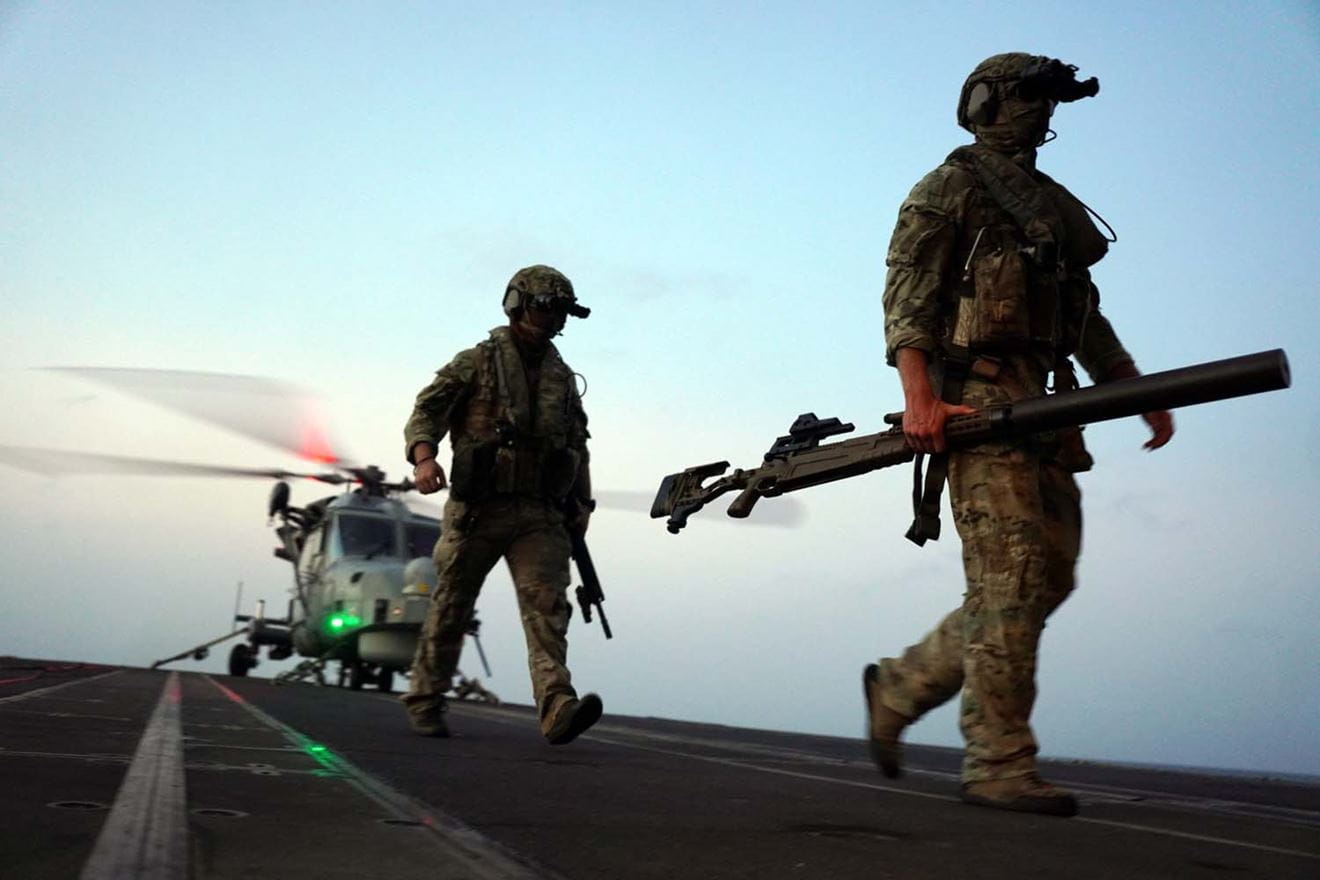
Commando snipers brought the skiff – zipping over the waves at speeds in excess of 40 knots while its crew tried to ditch their illegal cargo – to an immediate halt with a bullseye shot to knock out the boat’s engine.
The snipers took aim from a Wildcat helicopter launched from the warship to intercept three suspect craft in one of the most dramatic counter-drugs intercepts the Royal Navy has been involved with in the Middle East.
This is the first time snipers have been called upon to use non-lethal force to disable a suspicious boat in the Gulf region – where typically slow-moving dhows are used to hide the illicit cargoes – unlike the Caribbean, where the tactic has proved effective on several occasions.
The operation began when HMS Lancaster launched her Wildcat from 815 Naval Air Squadron on a dawn patrol over the Gulf of Oman.
Her crew soon picked up three suspicious skiffs travelling at speed – and secretly shadowed them while relaying critical information back to the warship.
That allowed Lancaster to launch her Peregrine mini-helicopter drone to continue monitoring the skiffs – again undetected – providing a live video feed to the ship’s operations room.
Meanwhile, the Wildcat returned to refuel and embark a Maritime Sniper Team from 42 Commando – the Royal Marines’ specialists in boarding operations – to close in for the interception.
When the helicopter appeared over the skiffs, their crews immediately increased speed to more than 40 knots and began hurling their cargo into the water to reduce weight.
Ultimately, it led to two of the skiffs being abandoned – but not the third which persisted in trying to get away.
At this point, the marines targeted the outboard engine, neutralising it with a single round, while crew of the warship’s sea boat recovered the discarded packages and located a partially-submerged abandoned skiff.
More than 1½ tonnes of drugs were recovered in all – heroin, crystal methamphetamine and hashish with an estimated UK street value in excess of £35M.
The operation highlights HMS Lancaster’s capability to deter illicit activities and disrupt the narcotics trade.
“I’m hugely proud of the team’s professionalism, patience, and skill throughout what was a protracted chase,” said Commander Sam Stephens, Commanding Officer of HMS Lancaster.
“This operation saw Lancaster’s crewed and uncrewed aircraft working hand-in-glove under the direction of the ship’s operations room. The outcome was a highly-successful bust, removing large quantities of narcotics from the streets and preventing their profits from fuelling extremism.”
Wildcat pilot Lieutenant Guy Warry added: “Non-lethal disabling fire has not been seen in the region and was essential in preventing the drug runners from moving their product.
“Being the Wildcat pilot carrying out a live weapons firing on drug-running skiffs whilst flying backwards to provide a stable platform for the snipers was definitely a career highlight.
“This interdiction is a true testament to the high levels of training that both the flight, MST and ship have achieved prior to the bust.”
The ship’s success was praised by Minister for the Armed Forces Al Carns.
“Halting a boat travelling at 40 knots with a single non-lethal shot from a Royal Marines sniper is remarkable, and a real testament to the skill and training of our personnel,” he said.
“This operation highlights the unique role our Royal Navy contributes, working to disrupt criminal operations around the world, keeping us secure at home and strong abroad.”
It’s the first bust Lancaster has scored since she intercepted a £30m shipment of illegal narcotics in late May.
Direct from the front-line, the official newspaper of the Royal Navy, Navy News, brings you the latest news, features and award winning photos every month.