Navy News
Direct from the front-line, the official newspaper of the Royal Navy, Navy News, brings you the latest news, features and award winning photos every month.
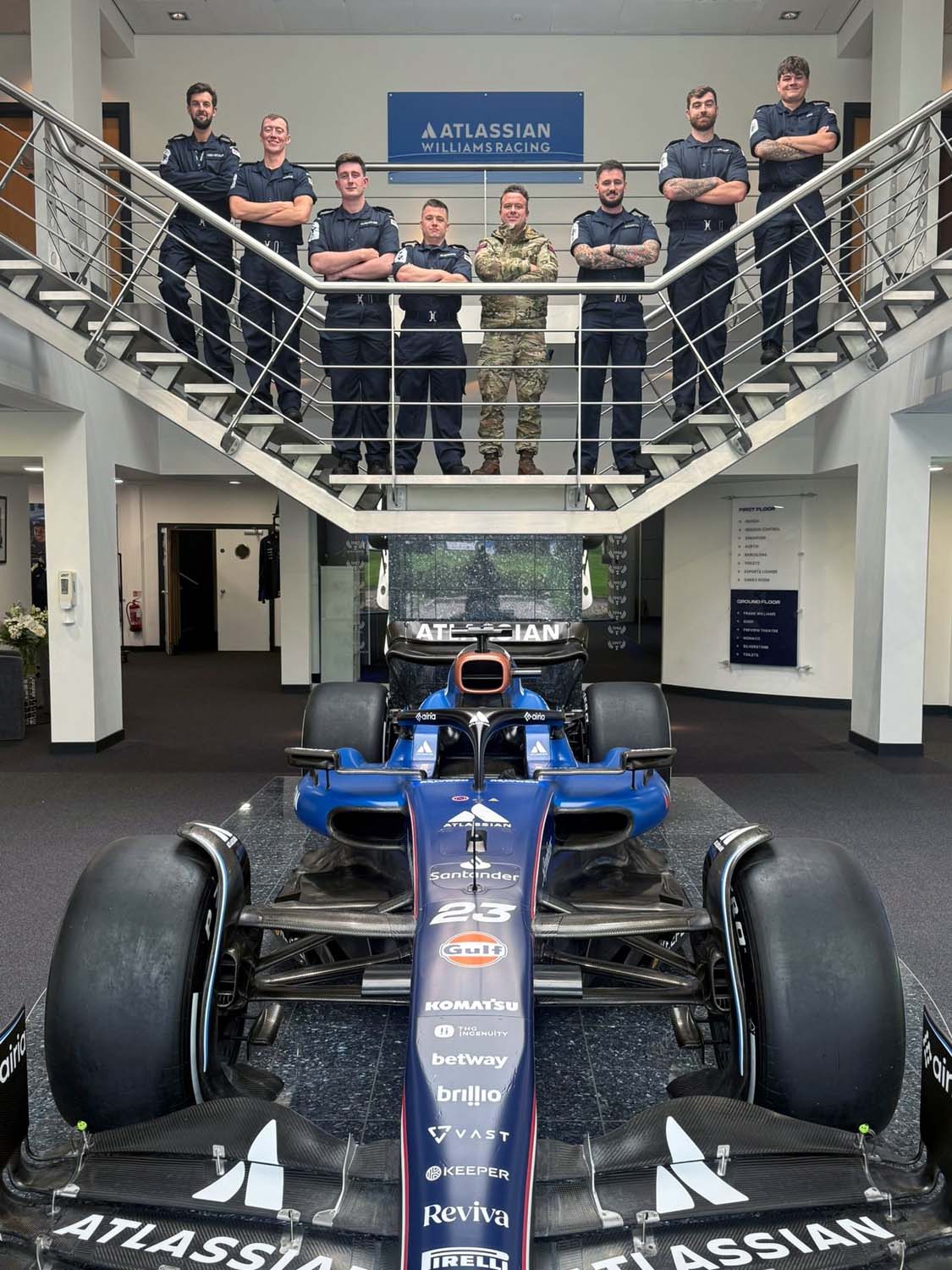
Eight engineers from three Forward Support Units – Archimedes, Brunel and Campbell – headed to Grove in Oxfordshire to broaden their knowledge base of leading-edge mechanics and engineering (fittingly known as ‘Project Explore).
Williams is one of the great names in Formula 1 with seven driver’s championships and nine constructor’s titles to its name down the years.
And the FSUs provide vital engineering support both at home and abroad to ensure the surface fleet can continue front-line operations.
Williams’ Grove facility includes an Experience Centre where ‘heritage tours’ are provided with the aim of gaining an insight into the finer engineering details applied by a world class sporting team.
Upon arrival, the sailors were struck by the immaculate surroundings and professional aura of the Formula 1 team, as an enthusiastic tour guide ran through the current parts of the F1 set up; the sheer intricate detail contained in a Formula 1 steering wheel proved an eye opener.
The visitors then had the opportunity to try on a replica helmet, were left in awe by the lightness of an F1 seat, as well as the side pod of the car - all made out of carbon fibre to combine weight efficiency while maximising the structural integrity of the vehicles.
The engineers then explored the fuel components and were similarly impressed by the configuration of the fuel tank.
The Williams F1 museum houses around 38 cars, ranging from the inaugural model from the 1970s to today’s car as driven by Alex Albon and Carlos Sainz.
As well as the fascinating history of Williams legends – Nigel Mansell, Damon Hill, Nelson Piquet, Ayrton Senna through to more recent drivers such as Valtteri Bottas and Nico Rosberg - the sailors learned about the advancement of aerodynamics and how engineers had adapted the shape of the cars to minimise drag.
While F1 teams invest millions in wind tunnels each season for testing, the engineering feat behind adapting testing into new, successful, designs is incredibly impressive – and a significant factor in Williams’ success over the years.
The naval engineers were introduced to active suspension – each wheel’s suspension is adjusted throughout a lap to provide optimum speed around corners. It’s been banned since 1994, but the engineering science behind it remains valid and fascinating.
Tour over, the sailors were invited into the presentation suite to watch qualifying for the Azerbaijan Grand Prix, listening in to the live communications between the pit wall and drivers. The sailors were struck by the amount of information being fed to Albon and Sainz as they hurtled around the race track at speeds of 200mph.
With Sainz posting Williams’ first front-row start in nearly a decade, it made for a memorable day all round, said Sergeant James Hollman who coordinated the visit.
“It was a fantastic day which gave the team a real insight into the amazing level of engineering that goes into a modern Formula 1 car,” he said.
“Being invited to watch the qualifying session on completion of the tour also proved to be a great experience, particularly given the breakthrough result for the team.”
Commander Will Jones, Commander Operational Support with Surface Flotilla, added: “The visit to Williams F1 highlights the core intent of Project Explore: to broaden the engineering knowledge base of our FSU engineers.
“It’s about exposing our engineers to high-performance environments, advanced technologies and alternative approaches to problem-solving. By engaging directly with organisations at the forefront of innovation, we equip our personnel with insights that could be translated into practical solutions for naval engineering challenges, strengthening our ability to deliver smarter, faster and more resilient support to the Fleet.”
Direct from the front-line, the official newspaper of the Royal Navy, Navy News, brings you the latest news, features and award winning photos every month.