Navy News
Direct from the front-line, the official newspaper of the Royal Navy, Navy News, brings you the latest news, features and award winning photos every month.
There’s nowhere better.
And getting there a day earlier than planned after nearly eight months away, well that’s the icing on the cake.
The curtain came down on the Royal Navy’s premier deployment of 2025 over the weekend as the UK Carrier Strike Group in all its many parts returned home.
Sometimes they were intimate affairs.
Others were watched by a cast of thousands. Some took place in the rain. Others were blessed with a weak winter sun and raw westerly breeze.
In Norfolk. In Somerset. In Cornwall. In Devon. In Portsmouth.
All came home with a sense of mission accomplished – and delight at being reunited with families. Bad weather forecast for tomorrow brought the arrival of the four ships in the strike group at the end of its Operation Highmast mission forward by 24 hours: HMS Dauntless, then flagship Prince of Wales and finally Norway’s HNoMS Roald Amundsen to Portsmouth, HMS Richmond into Plymouth. As is their custom, the aircraft departed ahead of the ships’ arrival.
The F-35B Lightning jets were safely back at RAF Marham by Friday lunchtime, the Merlins of 820 Naval Squadron to Culdrose, four Wildcats from 815 NAS (deployed with HMS Prince of Wales, Dauntless and the Amundsen) to Yeovilton (the Merlins of 845 arrived a week ahead of the rest, their work done).
Commander Nick Smith led 809 Naval Air Squadron, nicknamed The Immortals, on its maiden deployment, bringing them back to Norfolk alongside their RAF sister Lightning squadron 617.
He said “the range and breadth of the activity the squadron have been part of is truly amazing”.
He continued: “I am incredibly proud of the Immortal Team who have done such a fantastic job in delivering everything asked of them throughout the year, but most importantly full operating capability of Carrier Strike.
“We have operated day and night, in fair weather and torrential downpours, from HMS Prince of Wales as well as the Japanese and Italian ships Kaga and Cavour."
After being reunited with families, air and ground crew – as in 617 Sqn, drawn from the RAF and Royal Navy in equal measure – now enjoy a month’s leave “before regrouping in 2026 for another year of adventures”.
Guiding one of the Merlins on to dispersal at Culdrose was Air Engineering Technician Taylor Kiltie. Aboard, his dad and fellow aviation engineer Petty Officer Andrew Kiltie.
“I am absolutely delighted to be back here with my family. It’s such a long time to be away, so to come back straight into their arms – it’s very emotional,” dad said.
Commander Al Woodward, who took command of the anti-submarine/airborne surveillance squadron just before the deployment, said the eight months away would live long in the memory for many reasons.
“It’s been a superb deployment looking at what we’ve achieved. The squadron has been incredible. They’ve worked so hard at the challenge of keeping the aircraft serviceable and safe so we can fly. “There have been a lot of exercises and we’ve been half-way around the world and back.
“We’ve also been to some incredible places. These are the memories, as well as the successes. I hope people will look back fondly on this deployment. And it’s great to be home.”
I hope my sailors walk off the ship with a bit of a swagger knowing they have made a difference for their country.
In Plymouth, HMS Richmond’s return was announced by a gun salute as she passed The Hoe and Drake Island while families waited at Devil’s Point and on the jetty.
Richmond’s Navigator Lieutenant Oliver Thomas safely guided the frigate around the port and a string of ports British warships visited infrequently.
“In South Korea you had skyscrapers all along the front, and in the background stunning mountains – something we had never seen," he said.
“The hardest part of the deployment was coping with temperatures. Crew working for six hours on the upper deck in 40-degree heat and 90 per cent humility – really intense conditions we are not used to in Britain.
“So some people have been looking forward to colder climes, including myself, and even a little bit of rain.
“At times knowing what food you were going to get when eating ashore could be interesting – some of the crew had a few surprises when struggling with translations!”
Chef Able Seaman William Diffu said he and his colleagues in HMS Richmond’s galley had enjoyed the challenge of showing what they can do – for VIPs and guests during diplomatic events, but above all for their shipmates.
“Making people happy with good food, especially if they might be feeling a bit low – that’s our job. Bringing joy to people,” he said.
His shipmates loved beans and sausages for breakfast (and complained if the latter weren’t British), were served up shark on one ‘fish Friday’ (“surprisingly enjoyable”) and above all relished a steak.
“It’s been a great deployment, but it’s lovely to be home. I am overwhelmed with joy to be back.”
For the frigate’s Commanding Officer Commander Rich Kemp, the deployment reaffirmed the concept of the Carrier Strike Group – which was declared ‘fully operational’ shortly before Highmast ended.
“We can do this – we’ve done it before, we can do it again and we can do these deployments with our partners. That’s the best lesson which could be learned,” he said.
He hoped the men and women under his charge would walk down the gangway in Devonport “with a bit of a swagger knowing they have made a difference for their country”.
He continued: “Everyone aboard has an important role to play and everyone has done the Navy proud. |I’ve been impressed on a daily basis. We have been to a part of the world the Royal Navy doesn’t regularly visit, worked with some countries we do not regularly work with and we’ve delivered in spades.”
Despite the early hour – just after sunrise on a Sunday – HMS Dauntless’ return was well attended with a good smattering of early birds both on the waterfront and family members on the jetty waiting for the ship, such as Jenny Walley's family who all donned masks featuring the leading hand’s face.
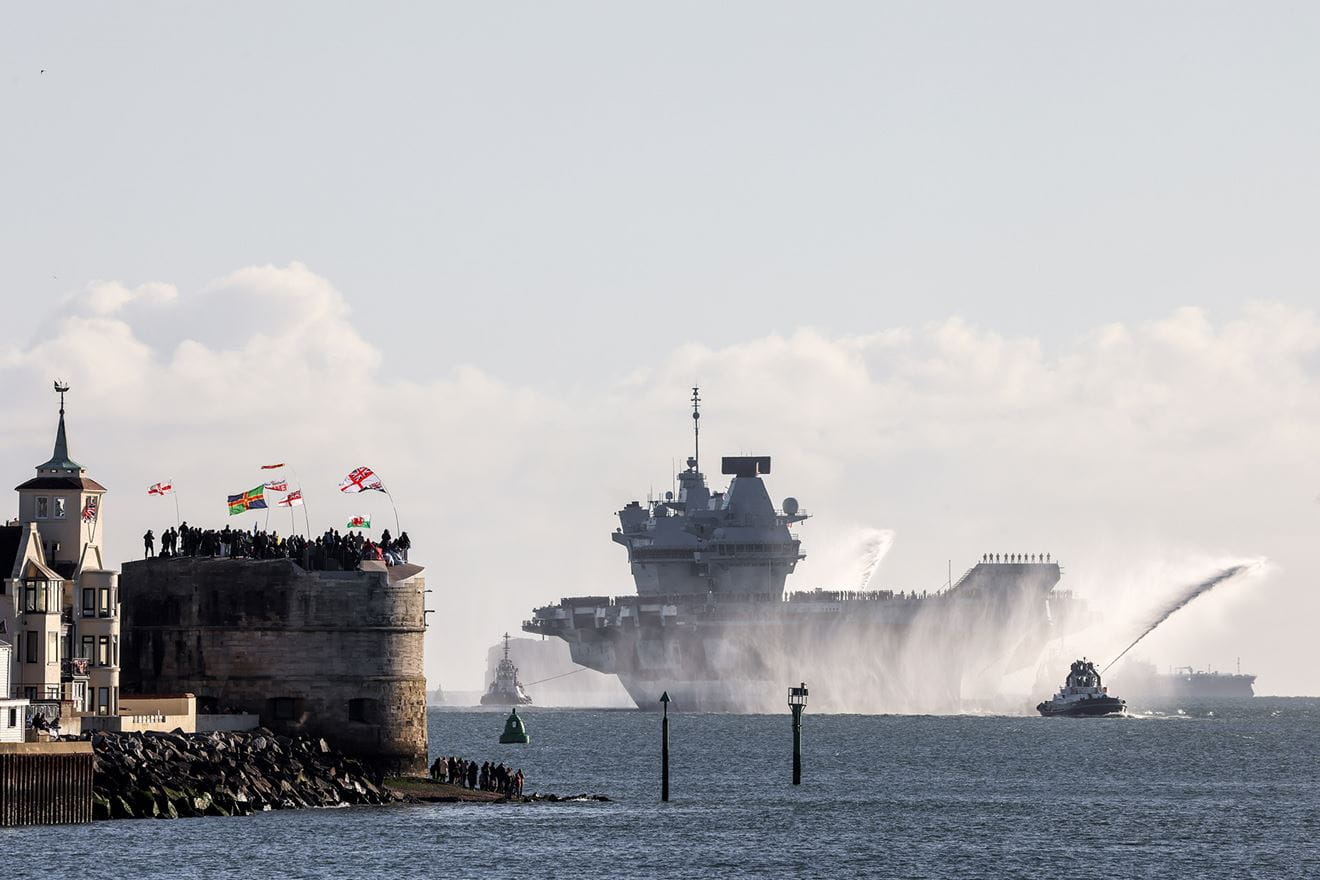
As for the big one, well HMS Prince of Wales received a welcome befitting a flagship. Crowds lining both sides of the harbour entrance. Tugs spewing arches of water ahead of the ship. A Merlin and Wildcat flypast. A 17-gun salute. A wall of banners, flags and posters on the Hot Walls, Round Tower and Princess Royal Jetty.
As many as 6,000 family members had been expected quayside originally; bringing the carrier in 24 hours earlier than planned meant some couldn’t make the make the occasion.
Among those who were able to rearrange plans was Lieutenant Simon Hall from Yeovilton, whose wife Lieutenant Commander Phoebe Hall joined the flagship at the half-way point of the deployment. The couple’s five-year-old daughter held a banner aloft so mum could spot her easily. She’s now looking forward to decorating the family home for Christmas with her mum.
“Having her back for the special season is the icing on the cake,” said Simon. “Phoebe joined in Japan so it's been four months of solo daddying whilst maintaining the day job but Ophelia has made it easy for me.”
Chief Petty Officer Chris Aspin’s family – wife Anne and children Jessica, 13, and nine-year-old William – had made the 250-mile trip from Manchester to be reunited.
“We haven't seen him for the whole eight months, it's been hard,” said mum. As for his eldest child: “I haven't missed beard rash and him standing in front of the TV, but I've missed him a lot.”
Led by HMS Prince of Wales, the Carrier Strike Group has comprised a core defensive ring of steel, provided by HMS Dauntless (air defence), HMS Richmond and HNoMS Roald Amundsen (anti-submarine and surface defence).
Tanker RFA Tideforce supported the final month of the deployment, while her sister ship RFA Tidespring, provided fuel for the force through three-quarters of the Highmast mission and Norway’s HNoMS Maud performed tanker duties during the opening weeks.
In all, the strike group comprised warships and support vessels from ten nations – Australia, Canada, France, Italy, Japan, New Zealand, Norway, Portugal, Spain and the USA – and worked with more than 30, sailing more than 40,000 miles (more than 1½ times around the world) to the western Indo-Pacific; more than half the mission was spent east of Suez.
Fifth-generation F-35B Lightning strike fighters of RAF 617 Squadron (The Dambusters) and the Royal Navy’s 809 Naval Air Squadron have provided the fast jet firepower, with up to 26 jets embarked at points.
They have been supported by Merlin and Wildcat helicopters from 814, 815, 820, and 845 Naval Air Squadrons, plus drones from 700X which have been pushing the boundaries of uncrewed air operations, in particular transferring supplies between ships in the group.
They returned home with the Carrier Strike Group concept declared fully operational – and ready to assume NATO duties, testament said Commodore James Blackmore, the Commander UK Carrier Strike Group, “to the hard work both on Operation Highmast and of those who have served before us to reach this milestone.
“The Strike Group has come home stronger for NATO than it departed and I am incredibly proud of all those who have taken part in Operation Highmast.”
HMS Richmond’s Executive Officer Lieutenant Commander James Callender, said he “could not be prouder” of his shipmates for all they had achieved. “Whether it be supporting UN Security Council resolutions in the Yellow Sea or hosting dignitaries and VIPs for high level engagement, Richmond has continued to deliver in spades.”
The jets, helicopters, and drone/uncrewed aircraft have flown more than 2,500 sorties in support of the deployment which sought to demonstrate the UK’s commitment to global security with its allies.
Highmast took the Task Group to northern Australia for the country’s largest military workout, Exercise Talisman Sabre, followed by a similarly-complex and large-scale exercise with the US and Japanese maritime forces.
In all the force operated/exercised with nine different carrier groups, with its jets landing on four different aircraft carriers. Ships helped to enforce UN sanctions against North Korea, supported NATO security operations in the Mediterranean and promoted British interests and industry wherever they have visited.
Personnel were able to enjoy some unforgettable experiences and opportunities: climbing Mount Fiji in Japan, encountering crocodiles in northern Australia, a string of international cookery contests, sporting fixtures, and visits to some of the world’s great cities including Tokyo, Singapore, Ho Chi Minh City, Manila, Mumbai.
There have been celebrations – the traditional naval ceremonies of Crossing the Line (Equator) and Trafalgar Night – while HMS Prince of Wales’ rock band were invited to play their debut public gig at Singapore’s Hard Rock Café.
And there were solemn moments with commemorations at military cemeteries and sacred sites throughout the deployment, including a service of remembrance for the crew of the previous HMS Prince of Wales over the wreck site in the South China Sea – the first time today’s ship has visited.
Direct from the front-line, the official newspaper of the Royal Navy, Navy News, brings you the latest news, features and award winning photos every month.