Navy News
Direct from the front-line, the official newspaper of the Royal Navy, Navy News, brings you the latest news, features and award winning photos every month.
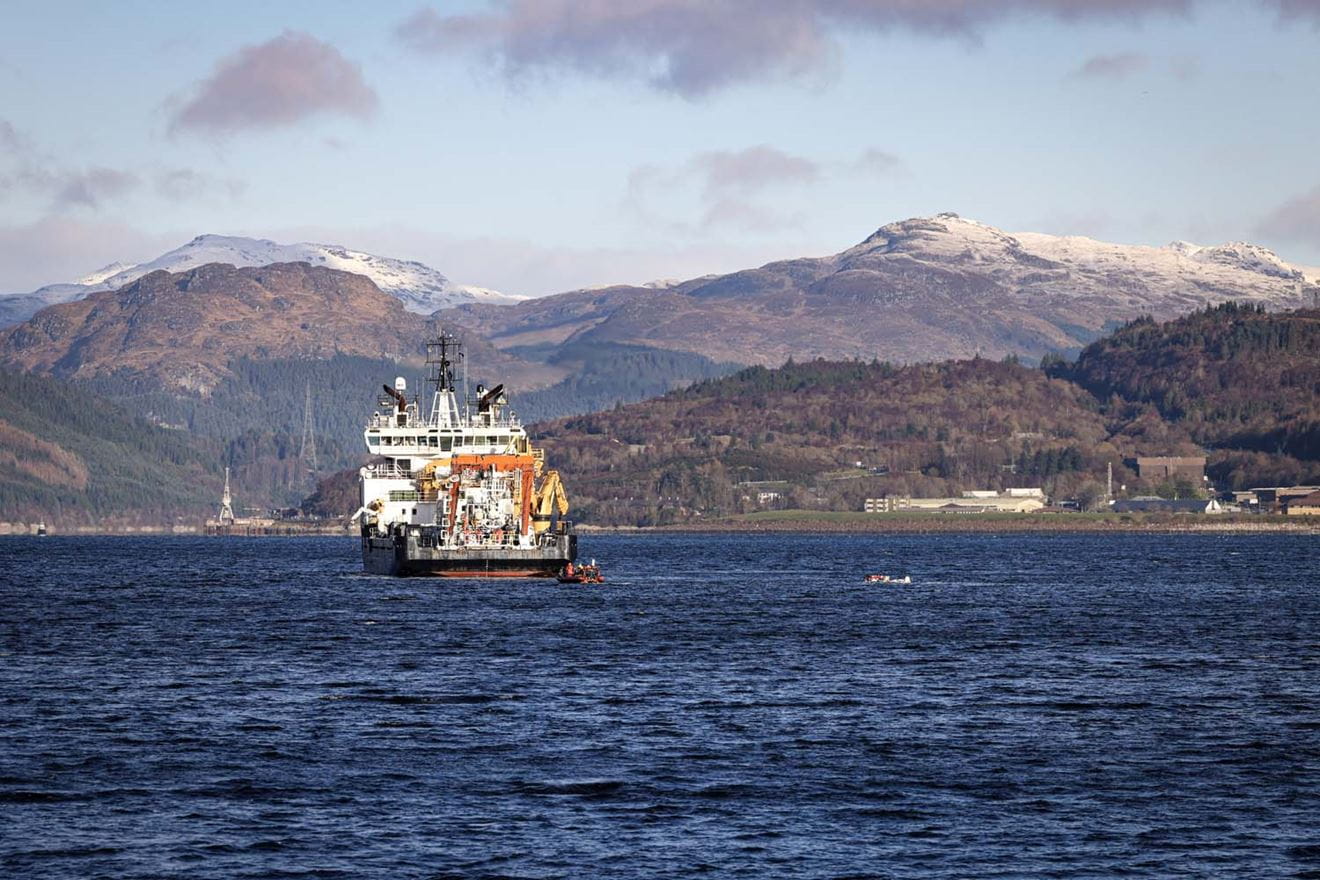
The NATO Submarine Rescue System (NSRS) and 150 expert personnel are poised at all times to deploy wherever in the world they are needed to provide a lifeline for submarine stranded beneath the waves.
Fifty divers and medics from the three nations headed to Loch Long near the Firth of Clyde, taking the system – including remote-controlled vehicle and crewed submersible Nemo – aboard auxiliary ship SD Northern River from Glasgow.
Once in the loch, the NSRS crew were tasked with a rescue mission, ultimately ensuring their equipment is safe to use and their skills are kept at the highest standard for their crucial operations.
The main focus was to launch, dive and recover the system’s submarine rescue vehicle (SRV), Nemo, which can carry up to 12 people and is designed to bring submariners back to the surface and includes a chamber for safe decompression.
NSRS Operations Officer and Senior Rescue Element Commander, Commander Chris Baldwin, said: “These exercises are key to assuring the Fleet Commander that NSRS is operationally poised and available as a global submarine rescue capability; ready to respond and support the rescue of submariners wherever it may be needed.”
Nemo conducted “mating” procedures – the process in which it attaches to a distressed submarine.
The vessel was manoeuvred carefully to a simulated submarine casing, onto which the pilot positioned the “mating skirt” to achieve a watertight seal between Nemo and the target.
Then, the rescue chamber operator – working in the back of Nemo – opened the hatch just as if it was a distressed submarine on the seabed.
In the event of a real incident with a submarine, this is how a crew could be rescued. For this exercise, two Norwegian Naval personnel were acting as rescue chamber operators.
NSRS Engineering and Logistics Support Manager and Authority Deployment Officer, Rob Penfold, said: “In addition to demonstrating the rescue operational capability, these exercises provide real evidence of how multiple engineering safety standards are interfaced.
“From logistic delivery and mobilisation to the ship, to installation, test and commissioning of equipment, providing confidence that the system is safe to operate even in operational emergency situations at sea.”
Additionally, senior officers from the French Navy completed their qualification as Rescue Element Commanders (REC) during the exercise.
HM Naval Base Clyde’s Diving Threat and Exploitation Group, Charlie Squadron, provided unique diving and recompression chamber expertise throughout.
The exercise also provided the opportunity for Charlie Squadron’s Commanding Officer, Lieutenant Commander Ross Balfour to qualify as a REC.
The NSRS, which is operated by the Submarine Delivery Agency, is a tri-nationally resourced capability.
Collectively known as the NSRS Operations Group, it comprises divers and medics from the UK, French, and Norwegian Navies, as well as medics and contractors from JFD Ltd. This year, personnel were joined by an observer from the Chilean Navy.Direct from the front-line, the official newspaper of the Royal Navy, Navy News, brings you the latest news, features and award winning photos every month.