Navy News
Direct from the front-line, the official newspaper of the Royal Navy, Navy News, brings you the latest news, features and award winning photos every month.
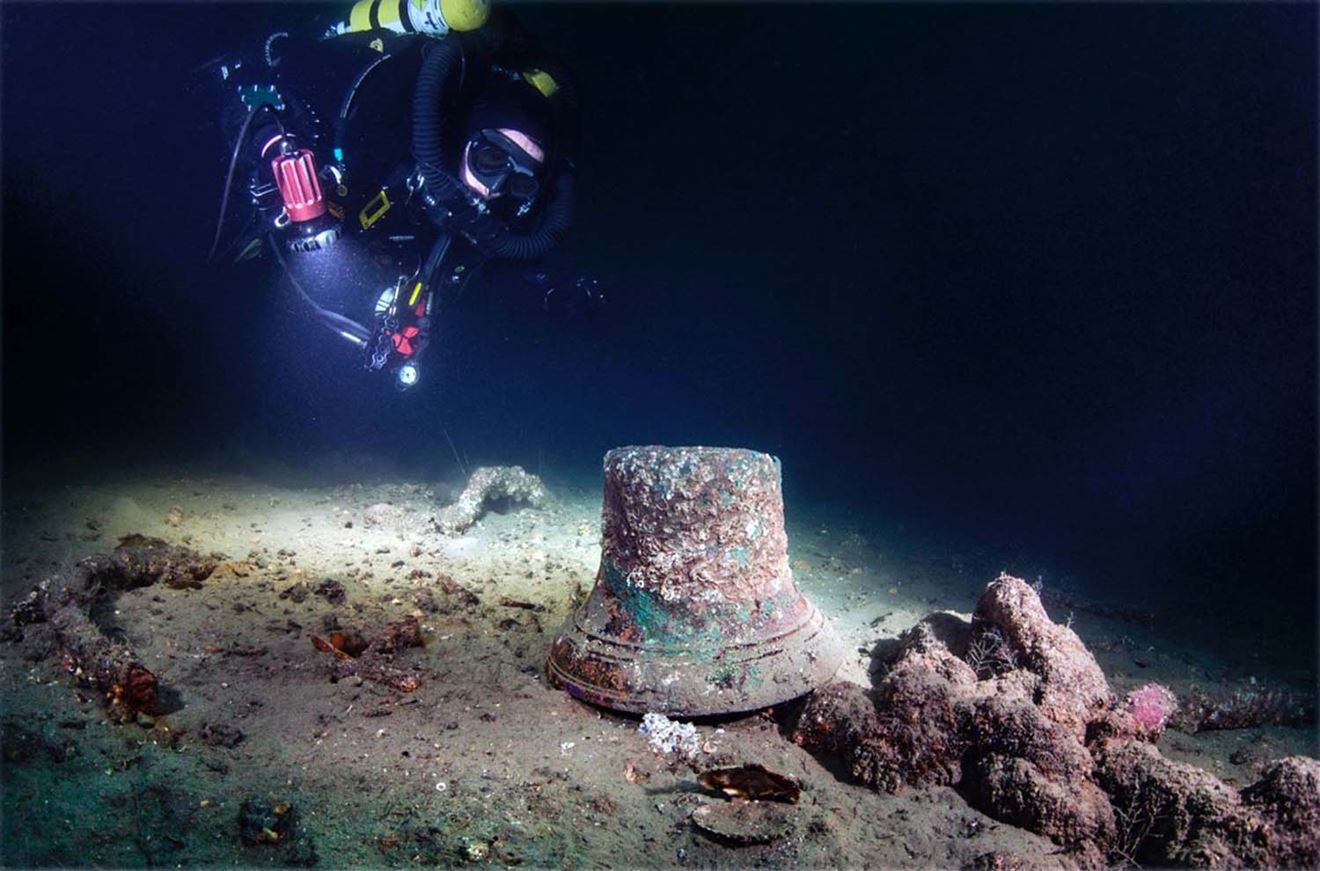
Divers have brought the bell, badge and tampion – gun barrel cover – of HMS Vanguard from the bed of Scapa Flow to the surface.
It’s the first – and most important – step in plans to create a new exhibition and memorial in Orkney to the 843 souls lost in a cataclysmic explosion in July 1917.
All three items now need to undergo specialist conversation – including making use of the experts who worked on the Mary Rose and its thousands of objects – so they can be seen by the public for the first time since Vanguard was afloat.
The battleship blew up for reasons never accurately determined, but it is thought that a long-smouldering fire in a coal bunker caused cordite charges in an adjacent compartment to ignite.
A series of explosions shook the dreadnought before a final blast tore her to pieces, showering Scapa Flow – the wartime anchorage of the Royal Navy – with metal and burning debris, which also set the Orkney heather alight. Just two of the 845 souls aboard survived.
The wreck – which is protected by UK law – lies 34 metres (111ft) down off the north shore of the Isle of Flotta.
A dive team from the MV Huskyan who surveyed the site nearly a decade ago as part of 100th anniversary commemorations of the Great War.
They again received special permission from the Royal Navy to both dive on the Vanguard and recover objects – as an official war grave, both activities are typically illegal.
The bell – which weighs 25kg and was damaged by the explosions – was the most challenging item to recover, but the divers brought all three objects to the surface in a single day’s work, despite poor visibility on the seabed.
All three objects were immediately transferred to sealed containers of salt water, which they’ll remain in while conservation work begins, while a minute’s silence was held over the wreck and wreaths dropped to conclude the operation.
“The objects are in phenomenal condition considering their age, the violent destruction of the ship and the long period of immersion,” said Nick Hewitt, naval historian and culture team leader for Orkney Council.
“They are also tremendously emotive – look at the bell and you will immediately feel what happened to that ship because it is distorted by the explosion and missing the crown which should be on top.
“This has been an amazing journey – three years of effort to date, and the whole recovery operation has been a great success. We’re absolutely thrilled. Mission accomplished.”
It will cost around £12,000 to conserve the three objects – after a century under water, each needs to be desalinated, cleaned and carefully dried before they can go on display, hopefully in around 18 months’ time.
Once treated, the recovered objects will form the centrepiece of a new exhibition dedicated to the ship and the men who served in her at the Scapa Flow Museum, alongside the life stories of those lost as part of the Vanguard Crew Photographs Project.
“We think the museum will become a focus for Vanguard commemoration, much like the Marwick Head memorial is for Kitchener and HMS Hampshire, and the Royal Oak memorial at Scapa Beach,” Nick added.
Direct from the front-line, the official newspaper of the Royal Navy, Navy News, brings you the latest news, features and award winning photos every month.