Navy News
Direct from the front-line, the official newspaper of the Royal Navy, Navy News, brings you the latest news, features and award winning photos every month.
For more than four decades, the seven submarines were at the forefront of underwater warfare, first as Cold War warriors, later adapting to a new world order when the Soviet Union collapsed.
Submariners of all ages who served in the boats converged on Devonport Naval Base to celebrate the accomplishment of the class – known affectionately as T-boats – and recall old times.
The formal act of decommissioning the last operational boat in the class, HMS Triumph, provided the occasion for the reunion in the base which the hunter-killers called home for most of their careers.
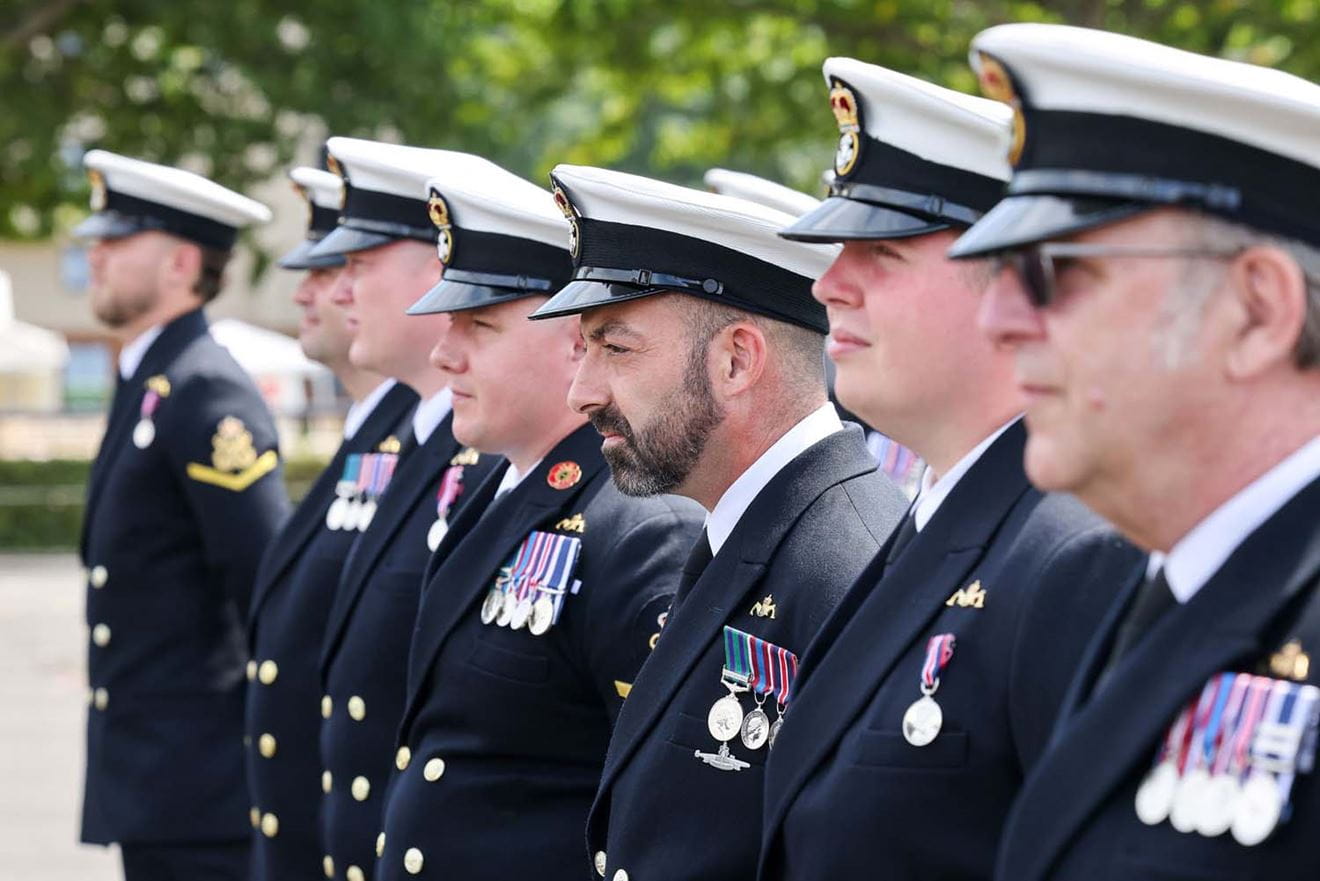
Crews of the last two T-boats in service, Talent and Triumph, held Divisions at HMS Drake in Devonport, with former Trafalgar crews invited to join them.
A Colour Party and Guard comprising submariners from Talent – which paid off three years ago but still has crew as part of the complex decommissioning process – and Triumph, as well as veterans from the Royal Naval Associations and Royal British Legion paraded in front of friends and families of the Submarine Service who had gathered for the occasion.
Taking the salute was Captain Dave Burrell, who served in a string of T-boats, was Executive Officer of both Talent and Triumph and, as skipper of HMS Trenchant, took her to the North Pole.
He was joined by Guest of Honour and Triumph’s Sponsor, Lady Hamilton (her husband was Armed Forces Minister when the boat was launched back in February 1991) .
Also enjoying proceedings was one of the UK’s oldest submariners, WW2 veteran John Harlow, veteran of patrols in WW2 and T-boat veteran from an earlier era, including service aboard HMS Truculent and Teredo.
Captain Burrell told all present he was mesmerised by the T-boats from the moment he first stepped aboard HMS Tireless in 2003. “The boat was a marvel, the people inspiring, and the mission was challenging.”
Since then he said the submarines “had become a second home” to him and cemented their reputation as workhorses of the submarine flotilla.
“They are the last of the Cold War warriors, although the Cold War never went away. We continued to play our dangerous game.”
He paid tribute to all who’d served in the class, not least Weapons Engineers Paul McCann and Anthony Huntrod who were killed in an explosion aboard HMS Tireless in 2007; the way the crew responded to the accident – during an Arctic patrol – was probably the finest moment in the history of the class, Capt Burrell said.
“I asked the Royal Navy’s most senior submariners how I should describe the Trafalgar class. They said simply: utterly brilliant submarines.”
Former nuclear engineer Craig Spacey, who served in Trenchant and Torbay, and now works for BAE was among the T-boat veterans who felt the pull to celebrate the class.
“Are there any interesting stories I can tell? No, we did a lot of missions which we cannot talk about,” he said. “But the T-boats were great, great camaraderie on board. You’ll probably get the same response from every submariner here: what keeps you in the Service is the people, the fun, the comradeship.”
Mr Harlow, who hails from south Devon, was delighted to be among honorary guests. “This is absolutely great – I cannot believe it. We are different ages and we talk different languages but I understand what they have gone through being under the water.”
Since 2009, when the first of the seven successor Astute-class submarines arrived on the scene, the boats of the Trafalgar class have been gradually phased out. HMS Agamemnon, which is almost complete in Barrow, will replace HMS Talent, while Triumph’s duties will ultimately be taken up by the final A-boat, HMS Achilles, later this decade.
Collectively T-boats have served for more than 200 years with Triumph completing the longest career of the seven submarines: 34 years.
Built to meet the demands of the Cold War, providing protection for the UK’s strategic nuclear deterrent by keeping hostile submarines away, the Trafalgar class boats have proved to be remarkably useful and versatile.
They’ve been used to gather intelligence, hit the UK’s foes by launching Tomahawk cruise missile strikes, serve as the springboard for commando raids and much more – many of their deeds remain classified.
Much of HMS Triumph’s lengthy career falls under that banner, but she has launched Tomahawk missiles on several occasions, firstly at Taliban targets in Afghanistan in the wake of the 9/11 attacks in 2001 and, a decade later, against Colonel Gaddafi’s forces during the uprising in Libya.
Capt Burrell concluded his address with a brief eulogy for the class of submarines: “It is time to rest easy Trafalgar, Turbulent, Tireless, Torbay, Trenchant, Talent and Triumph. It’s now someone else’s turn.”
Direct from the front-line, the official newspaper of the Royal Navy, Navy News, brings you the latest news, features and award winning photos every month.