Navy News
Direct from the front-line, the official newspaper of the Royal Navy, Navy News, brings you the latest news, features and award winning photos every month.
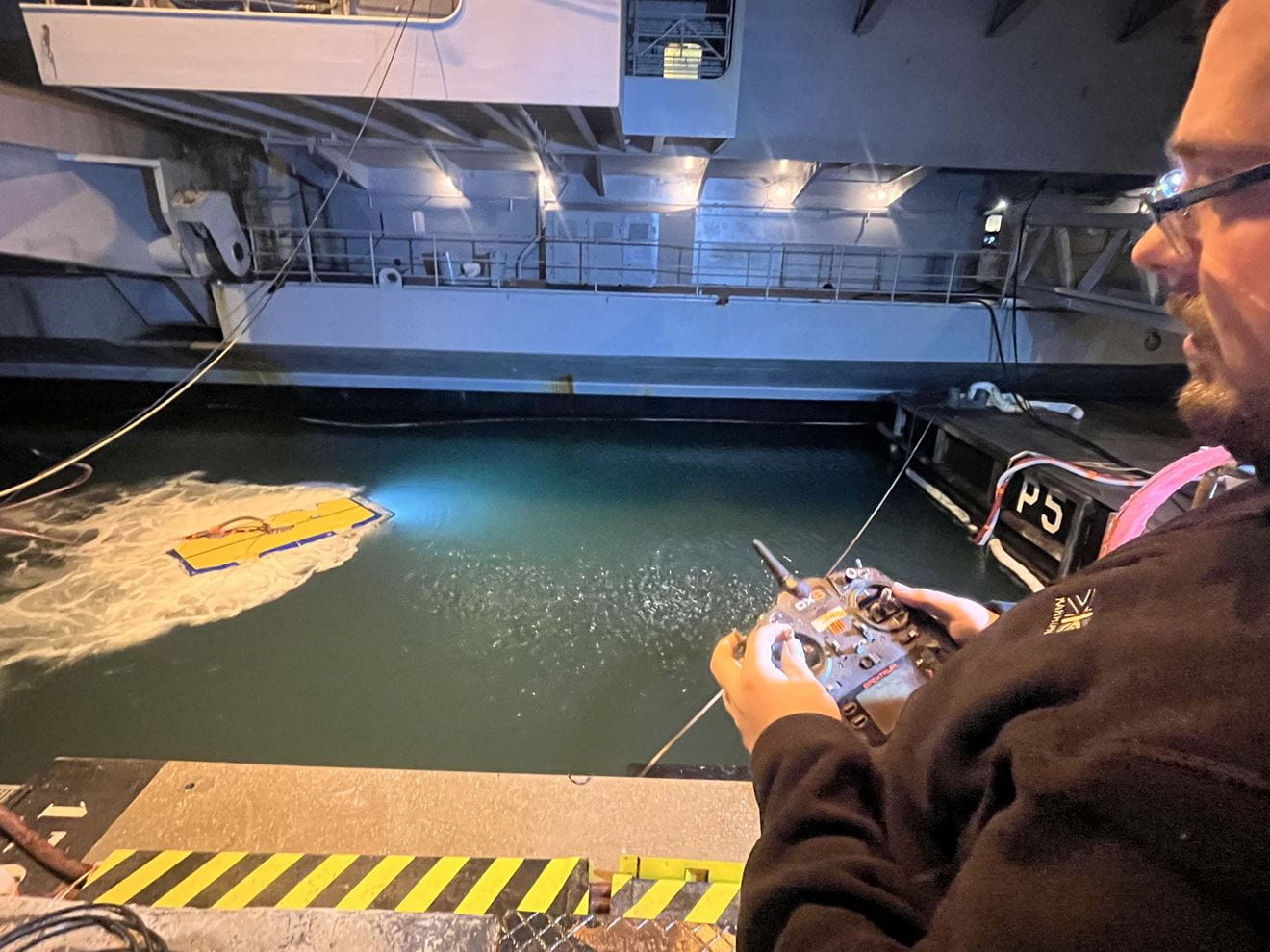
Harnessing the latest underwater technology, the hull of the French Navy’s aircraft carrier FS Charles de Gaulle has been inspected – and cleaned – in the water, without the need for a lengthy and expensive period in dry dock, or expert divers with specialist equipment.
The ground-breaking project was overseen by Royal Navy exchange officer Lieutenant Cam Dalley who’s assigned to the 41,000-tonne carrier.
It’s one of several joint projects involving the two navies under the Lancaster House Agreement between London and Paris.
In this instance, the Briton and his team were asked to look at ways of saving time, money and effort to keep the nuclear-powered carrier’s hull clean.
Hull fouling, caused by bio growth on underwater surfaces, reduces a vessel’s efficiency and speed – and increases fuel consumption.
The solution has either been to send divers down to painstakingly remove the fouling – or else take a ship out of the water, and blast the growth off in dry dock.
But Lieutenant Dalley said recent advancements in Remotely Operated Vehicles (ROVs) allowed both surveys and cleaning to be conducted in the water – and turned to the latest developments in industry and commercial shipping.
“We need to catch up with what industry is pioneering to keep costs down,” Cam explained. “The technology represents a step-change in preventive maintenance: allowing our ships to maintain desired speeds whilst lowering fuel consumption in a more efficient and sustainable manner.
“What’s even more impressive is the capacity to automate the procedure using the robot’s memory from previous cleans.”
What’s even more impressive is the capacity to automate the procedure using the robot’s memory from previous cleans.
A small, agile submersible conducts a visual inspection of the hull below the waterline as well as the external shaft-line, controlled – after a short period of training – by a ‘pilot’ on board.
If cleaning is required, a larger robot is submerged via remote control and latches on to the hull using sucker pads.
The bio growth is then drawn from the hull through an umbilical cord, into filters which quarantine it.
Any leftover seawater in the system is then discharged back into the basin which is cleaner than it was originally. And any contamination such as paint or bio debris can be analysed in the processing tanks prior to discharge to ensure environmental compliance.
Cam said the collaboration between the Brits and French had been key to developing the inspection/cleaning system – and that the trials to date had shown ‘wins’ on several levels: safer, cleaner, environmentally-friendly and compliant with laws, cheaper than existing methods and with potential for use throughout NATO.
The system is easily deployable in standard industrial/shipping containers, making it suitable for larger vessels such as carriers or auxiliaries.
Direct from the front-line, the official newspaper of the Royal Navy, Navy News, brings you the latest news, features and award winning photos every month.