Navy News
Direct from the front-line, the official newspaper of the Royal Navy, Navy News, brings you the latest news, features and award winning photos every month.
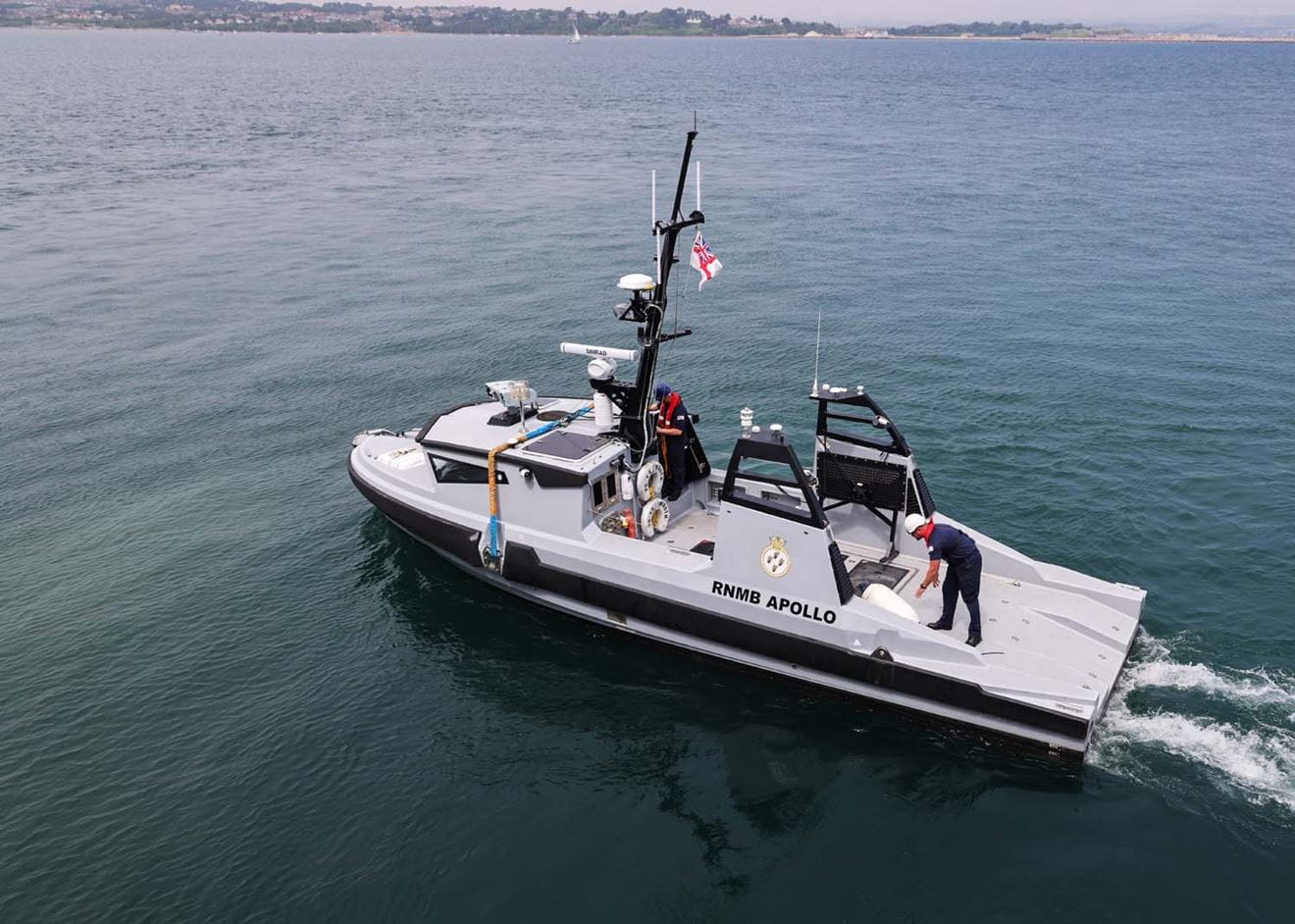
From trialling existing equipment in new environments to embarking crewless kit on a range of Royal Navy ships, it has been a busy few months for the various squadrons within the Mine and Threat Exploitation Group.
The MTXG and its specialist personnel, with support from the MOD’s Defence Equipment and Support (DE&S) organisation, have been refining the use of autonomous and uncrewed kit from launching underwater vehicles to integrating software in new systems.
In a milestone moment for the future of minehunting operations, MTXG’s Maritime Autonomous Systems Trials Team (MASTT) successfully completed a Degree 3 Autonomy serial, also known as conditional automation.
It proved the autonomous system – in this case uncrewed surface vessel Royal Navy Motor Boat Apollo – could handle most operational tasks independently under certain conditions.
The latest round of testing saw Apollo controlled remotely from a control centre and successfully carry out a pre-programmed mission and use the information given to it to avoid potential hazards.
Operators in the control centre continuously assessed a stream of different data feeds and sensors to ensure the mission was proceeding as planned and the vessel remained safe.
The trials, conducted in Weymouth Bay, aimed to rigorously test the system’s capabilities.
Lieutenant Commander Alan Hendry, Officer in Charge of MASTT, said: “The results of trials on RNMB Apollo were impressive, with the system demonstrating reliable path-planning and hazard avoidance capabilities based on information received.”
MASTT is now focused on further refining the system and preparing for an integration period later in the year with the UK’s new ‘minehunting mother ship’, RFA Stirling Castle.
Meanwhile Yankee Squadron Unit 1 has been working closely with DE&S trialling the Seacat maritime autonomous underwater vehicle.
Used for hydrographic surveying, Seacat was successfully launched and recovered numerous times over a four-week period showing its reliability and robustness in a range of conditions.
It uses an on board echo sounder and camera to relay real-time information back which can then be used to make decisions. The trials were the latest step of the Seacat being transferred into service.
Sister squadron Zulu took its equipment to ships within the Royal Navy, embarking on P2000s for the first time overseas to see how its minehunting equipment could be used in different locations and on different vessels.
They deployed a team of five to NATO’s annual Baltic exercise, embarking on HMS Puncher and HMS Pursuer.
The team took with them an IVER 3 Autonomous Vehicle, which operates independently, scanning the seabed with its sonar to identify potential mines and a Video Ray Defender remotely operated vehicle which sends a live stream back to the operator to safely find potential mines on the sea bed.
The trials helped to expand the number/types of ships mine warfare teams will be able to work with or from in future.
The results of trials on RNMB Apollo were impressive
Lieutenant Tim Pascoe, Executive Officer for the Squadron, said: “As the MTXG Squadron model matures, individual assets will be able to be embarked or forward-based to a variety of vessels and locations, allowing a single squadron to provide effect in and to suit a variety of locations and requirements simultaneously.
“This, combined with an increasingly mature data handling and transfer process, will allow Zulu and other MTXG squadrons to provide mine counter measures and seabed warfare support to the wider fleet with increased flexibility.”
The squadron also continued its important work of delivering survey operations in support of the nation’s nuclear deterrent throughout 2024.
Using equipment on board new ships and in new locations has also been the theme of work by X-ray Squadron.
They are based in the Gulf and have been trialling equipment in the seas of the Middle East. Equipment proven to function around the UK has been thoroughly put through its paces in waters where temperatures reachOh the 30C barrier in summer – almost double the highest temperatures of their usual testing ground in Scotland.
Their time at sea also gave X-Ray Squadron the chance to test a containerised uncrewed underwater base – a shipping container adapted for use in minehunting operations.
The container, known as Cube, was embarked on HMS Chiddingfold along with autonomous underwater vehicle Remus 300. It can search, survey and relay back crucial information in both minehunting and hydrography operations.
The Cube provides the ability to charge and maintain Remus while at sea and the completion of the sea phase of the trials means X-ray can now deploy on Hunt-class minehunting ships in the Middle East.
Remus 300 will continue to undergo rigorous testing at sea for further insight into future uses of autonomous underwater vehicles and their capabilities in the region.
The range of new systems and ways of working within the MTXG are taught by the Operational Conversion Unit, made up of eight personnel based in Portsmouth. Their jobs are designed to bridge the gap between the new equipment coming into service and a future training procedure.
They deliver training across the UK and abroad, using the wealth of existing experience within the mine warfare cadre.
Lieutenant Commander Dan Chandos-Hall, Officer in Charge of the OCU, said: “While there is still much to do, it is an exciting time as we move towards a training solution for the autonomous systems that will pave the way ahead for MCM Operations in the Royal Navy.”
Direct from the front-line, the official newspaper of the Royal Navy, Navy News, brings you the latest news, features and award winning photos every month.